Life for the Handicapped in Seoul

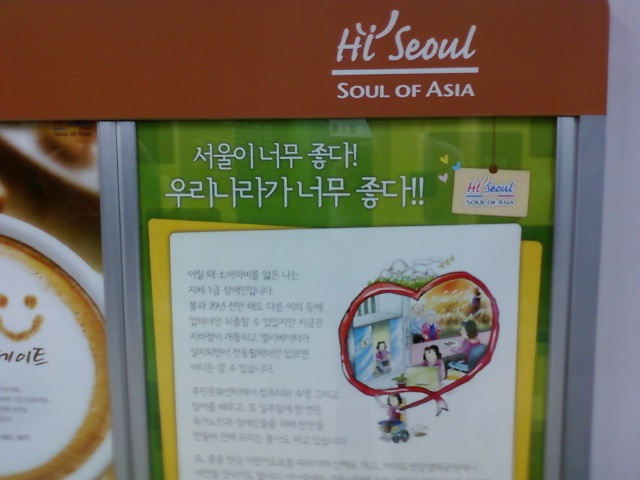
Seoul traditionally was not very attentive to the handicapped, but I have been impressed by recent efforts to make life more convenient for all citizens. There seems to be an effort to create a more open environment. Here a young handicapped woman exclaims, “Seoul is such a wonderful place.” She is referring to the ease of life. It would not be accurate to say that Seoul is particularly convenient, but an effort is being made these days.


Emanuel Pastreich
Circles and Squares

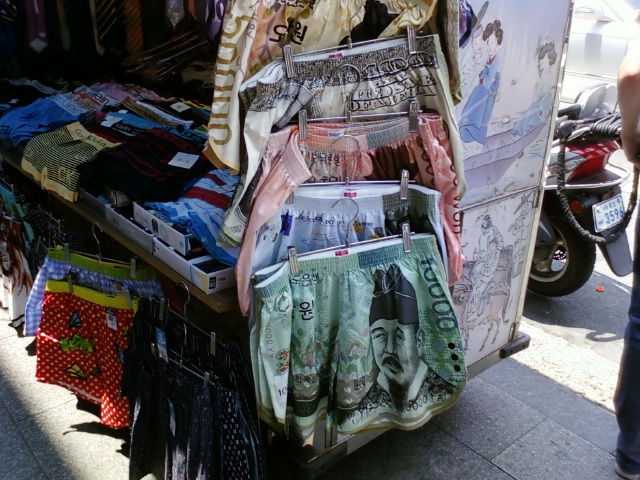
Money Pants in Seoul

I am not sure what to make of the underwear emblazoned with the currencies of the world that are for sale in Itaewon these days. I suppose they symbolize the coming collapse of currency itself as the process of mechanical reproduction reaches an extreme in this fluid age.


Emanuel Pastreich

Circles and Squares

Greening Seoul’s Soul

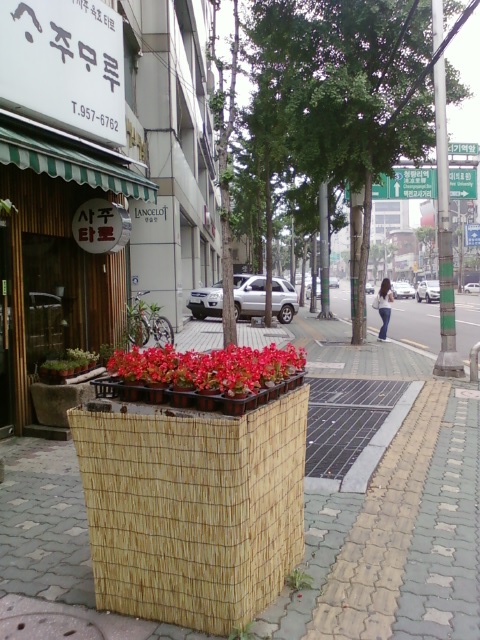
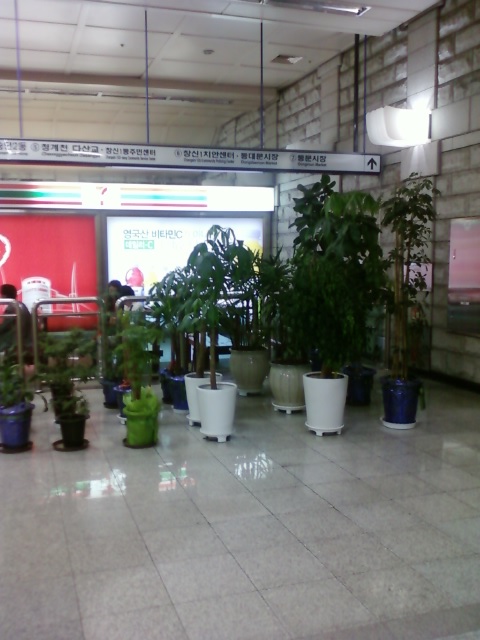
Seoul has suffered from a serious misconception of the meaning of real estate. It seems as if green space was deemed a waste in the building of houses and offices throughout the city. The are big parks, of course, but along most streets trees are not at the center at all. But we have seen over the last few years efforts to introduce plants at stores, in the metro, in every corner of the city. Often the efforts seems spontaneous.  There is a buried lover of plants and agriculture in Korea. Getting away from green was part of moving from the agricultural to the industrial economy. For the reason, neighborhoods should look green, but not too green. But at the same time, there is a nostalgia for the agricultural past just beneath the surface of Korea.

Of course, the plant are often placed in a make-shift manner, suggesting they can disappear at any moment.

Emanuel Pastreich

Circles and Squares

Agricultural goods on the subway

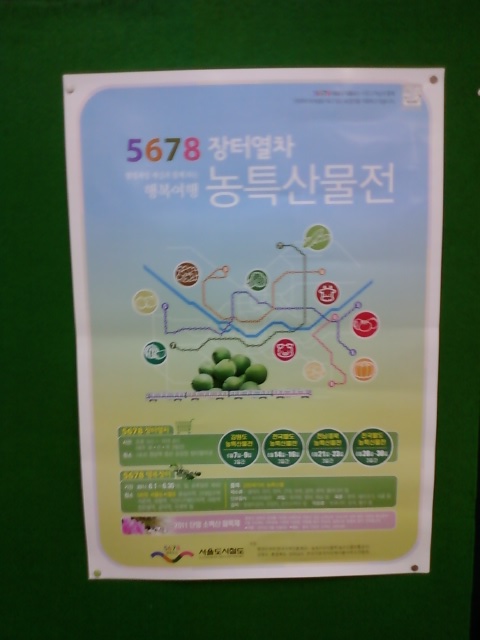
Seoul Metro is involved in a multidimensional project to reinvent what exactly subway means. One of the strongest indications of this project is the decision to set up fresh produce markets in the subway.  I was impressed by the quality vegetables available and the presence of such markets in what would otherwise be a desert makes commuting much more enjoyable. This metro sign identifies various fresh produce markets throughout Seoul Metro.

Emanuel Pastreich

Circles and Squares

Imagining the past in Korea

One of the oddest phenomena in Korea today is the nostalgia for a past that never existed in Korea. We see in advertisements little bits of memorabilia from a distant age in America, but that has no place in Korea today. In this first of these two pictures, we see a few fascinating artifacts that have little to do with anything Koreans might remember from childhood.

The second image is even more startling. I remember from my own childhood such classic VW buses. They are associated closely for Americans with the greening of America in the early 1970s after the terrible political conflicts of the 1960s. But Koreans have no personal memory of these buses, which were not sold in Korea as far as I can ascertain. It seems a special mythology of Korea has been created as cultural variation of the United States and bits of a rather alien origin have been imported into that Korean imagined past.

[slideshow]

Emanuel Pastreich

Circles and Squares

“What exactly is it that Koreans are Good at?”

I had a very intriguing conversation on Korea Business Central with Mike Park the other day in which we tried to answer that always elusive question:

“What exactly is it that Koreans are good at?”

The discussion started from a debate on the accuracy of my comments about Naver. Mike noted that:

———————————-

Korea is “globally competitive” and powerful with “single” solutions, but when solutions need to address “plural” or “multiple” groups, Korea is extremely weak.  Hence, “globally not competitive” when it comes to packaging-up and marketing new innovative ideas and concepts to different market segments/consumers.

Read more

Future Communications Forum (The Miso Forum) Wednesday, July 27, 2011

Emanuel will give a presentation at the Miso Forum (Future Communications Forum) on Wednesday, July 27, 2011, in the afternoon at 4:30  PM. The Miso Forum was founded by a group of concerned businessmen, academics and public servants who wish to explore new potentials for a deeper international dialog focused around Korea. I have been impressed by their dedication to the project.

Emanuel’s talk is entitled” “Future Communications: The Intellectual Korean Wave”

The entire conference is conducted in Korean.

The Miso Forum will be held at the Hanguk gisul Center (한국기술센터) (16th floor) –located next to

exit 5 of Seolleung Station on (Line #2). For more information, call: 02 247-8807.

www.koreams.co.kr

The Miso Forum 미래소통포럼

Read more

Take Naver Global Today! (ARTICLE)

Take Naver Global Today!

KOREA IT TIMES

Monday, July 18th, 2011

EMANUEL PASTREICH

http://www.koreabusinesscentral.com/forum/topics/take-naver-global-today

Korea has a unique search engine known as Naver (naver.com) which I frequently employ in my searches to find relevant information about Korea and the world. One need only spend a few minutes using Naver’s convenient maps, informative “café” discussion groups and interactive dictionaries to realize this search engine is unique in the world. The intelligent combination of search features, news features and social networking features in one site is quite powerful. Koreans are extremely picky consumers, but many prefer conducting their searches and socializing through Naver to Google.

Read more

Professor Doh Jung-il of Humanitas College

I wrote a few notes to introduce the rector of Humanitas College, where I am currently employed. Professor Doh Jung-il is a remarkable figure embodying the drive of the intelllectual to be engaged, and critical, in today’s society.  


Professor Doh Jung-il, Founding Rector

 Humanitas College, Kyung Hee University


Professor Doh Jung-il has emerged as one of the central public intellectuals arguing for the need for a new public sphere that is far broader than the classroom and intellectuals who are not afraid to address honestly the issues of our time. He has devoted his efforts to forming broad coalitions to support engagement in learning and volunteerism.   

Read more