한국은 현재 기로에 서 있다. 혁신적인 기술 개발, 새로운 비즈니스 모델과 디자인 창출을 추진하고 있음에도 이 모든 것이 단지 일시적인 현상인지 혹은 장기적인 전환인지 불확실하다. 삼성전자 현대차 등 대기업 이름으로 좋은 제품을 외국에 수출하고 있지만 아직까지 구글이나 마이크로소프트처럼 세상을 변화시킨 제품을 생산해 내지는 못하고 있다.
과거 한국은 세상을 크게 변화시킬 수 있는 기회를 가진 바 있다. 1372년 `직지심체요절`을 인쇄했던 세계 최초 이동식 금속 활자가 바로 그것이다. 안타깝게도 당시 금속활자는 세계적으로 영향력 있는 획기적인 혁신으로 나아가지 못했으며, 결과적으로 금속활자 기술 개발의 공을 고스란히 유럽인들에게 넘겨준 셈이 됐다. 무한한 가능성을 가지고 있음에도 세계로 나아가기를 주저한 결과 초래된 안타까운 역사적 사실이다.
Dr. Seungryu Lee serves as chairman of the Research Association for a Northeast Asian Community. This group meets frequently to discuss how economic, cultural and political integration between China, Japan and Korea can be achieved. The Research Association for a Northeast Asian Community met today (September 22, 2011) for a conference entitled “Constructing a Common Economic Community for the Korean Peninsula and the Search for a Path to Reunification.”
Emanuel visited the headquarters of RIKEN in Wako, Japan on July 29th to discuss with Professor Hara Masahiko concerning RIKEN’s a”Asia Research Network” and to learn about Professor Hara’s current research.
RIKEN has shown a strong commitment to international collaboration with a focus on Asia over the last few years. RIKEN has launched an Asia Research Network that at present includes representative offices in Singapore and Beijing to oversee initiatives and maintain close institutional ties with research institutes throughout the region.
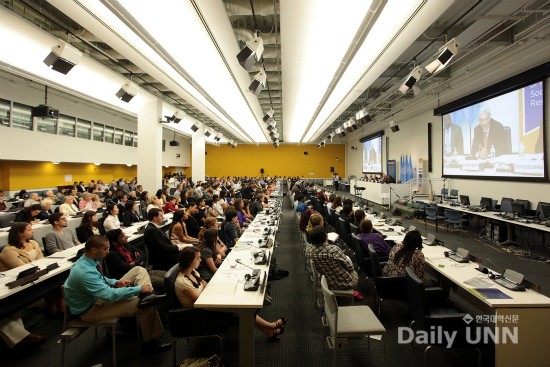
Kyung Hee University and the United Nations hosted a remarkable event entitled “Give Peace Another Chance” to commemorate the 30th anniversary of the establishment of the United Nations “Day of Peace.” The “Day of Peace” was originally proposed by the founder of Kyung Hee University and it was most appropriate that the United Nations chose Kyung Hee University for this event.
The event, which included speeches, statements by students, an address by Secretary General Ban Ki Moon and music performances, was split between United Nations Headquarters in New York City and Kyung Hee Campus in Seoul. Both groups were linked up via the internet.
More than 3000 students from ten universities were involved. The event was focused on United Nations Academic Impact (UNAI) an innovative program to increase the global role of universities and the commitment of students to proactive participation in local and global affairs.
Academic Impact aligns institutions of higher education with the United Nations in actively supporting the then principles of the UN in the areas of human rights, literacy, sustainability and conflict resolution. The Academic Impact also asks each participating college or university to actively demonstrate support of at least one of those principles each year.
Secretary General Ban Ki-Moon’s address to “Give Peace Another Chance” is available here.
The "Daejeon: Three Rivers" Logo that Emanuel Designed for the City of Daejeon.
Much of my work on the environment in Daejeon had to do with reimagining the city as an Eco City. I felt strongly, as do many of the citizens of that wonderful city, that until an awareness of the city as an eco city set in, we cannot make much progress. That is to say that Daejeon must be completely redefined as a cultural space. Such a development can take place as an extension of its status as a science park, of course.
We put together a wide range of proposals for the city as an eco city through the Daejeon Environment Forum back in 2009. Several, including the proposal for bike paths, received considerable attention. See here for more detail.
We also learned that implementation is another matter. Until the concept of “Daejeon” shifts, the importance of a massive investment in the environment will be obscure.
I designed this logo for Daejeon about a year ago and only today did it come out on a coffee cup. The logo draws attention to the ecosystem of Daejeon. Daejeon means literally “wide field” referring to a large expanse of green level land surrounded by mountains that makes up the region.
That space is defined by three rivers: the Gapcheon, the Daejeon Cheon, and the Yudeung Cheon. In fact, until the 1980s, the term “Three Rivers” 삼천 三川 referred to a large district in Daejeon. That underlying ecological formation, the true beauty of the city, has been obscured by the modernization process. Rediscovering it is essential to Daejeon’s, and Korea’s, future.
In addition, the logo features the expression “Daejeon Three Rivers” in English, Korean, Chinese/Japanese, French and Thai as a representation of the international nature of the city today. The three rivers flowing together also defines the cultural and global role of our beloved city.
We will have a new set up mugs out soon and encourage you to order some. We hope that all the major cafes in Daejeon will use these cups in the near future so as to promote such a new vision.
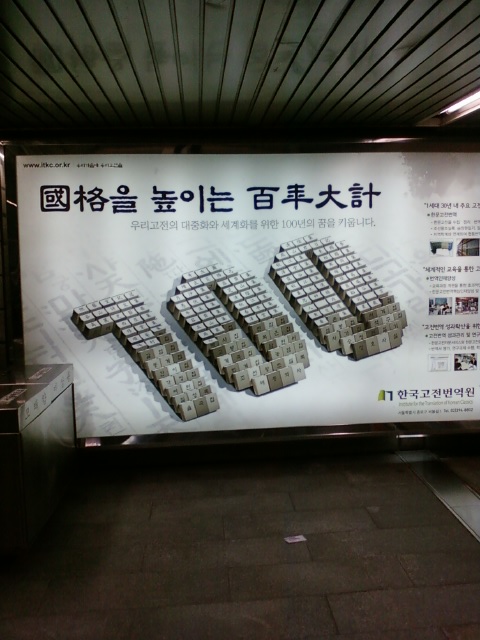
This Advertisement introduces the immense project being undertaken at present by the Institute for the Translation of the Korean Classics (한국고전번역원) to render large sections of the Korean literary and intellectual canon into contemporary Korean language. Because literary Chinese was the intellectual language of Korea until the twentieth century, there is a vast amount of the Korean tradition that is simply not accessible to contemporary readers. Few Koreans today learn classical Chinese. That discontinuity in the Korean cultural tradition is critical to understand how Korean culture is different that of France or Italy, nations in which a remarkable cultural continuity over the last thousand years remains intact. If you ask an educated Korean about the writings of a 17th century Korean philosopher, he or she would most likely stare at you blankly—with a few exceptions. But if you asked an educated Italian intellectual about a major Italian philosopher, he or she most likely has read some of the philosopher’s writings in the original.
The work of the Institute for the Translation of the Korean Classics is aimed at opening up the classical tradition to contemporary Koreans. The greater challenge will be making that tradition accessible to internationals. Although daunting, such an effort is absolutely essential if Korea is to get the recognition globally it deserves.
By the way, the situation is even more severe in Vietnam where also most of the writings until the 20th century are in literary Chinese but very little has been translated into contemporary Vietnamese.
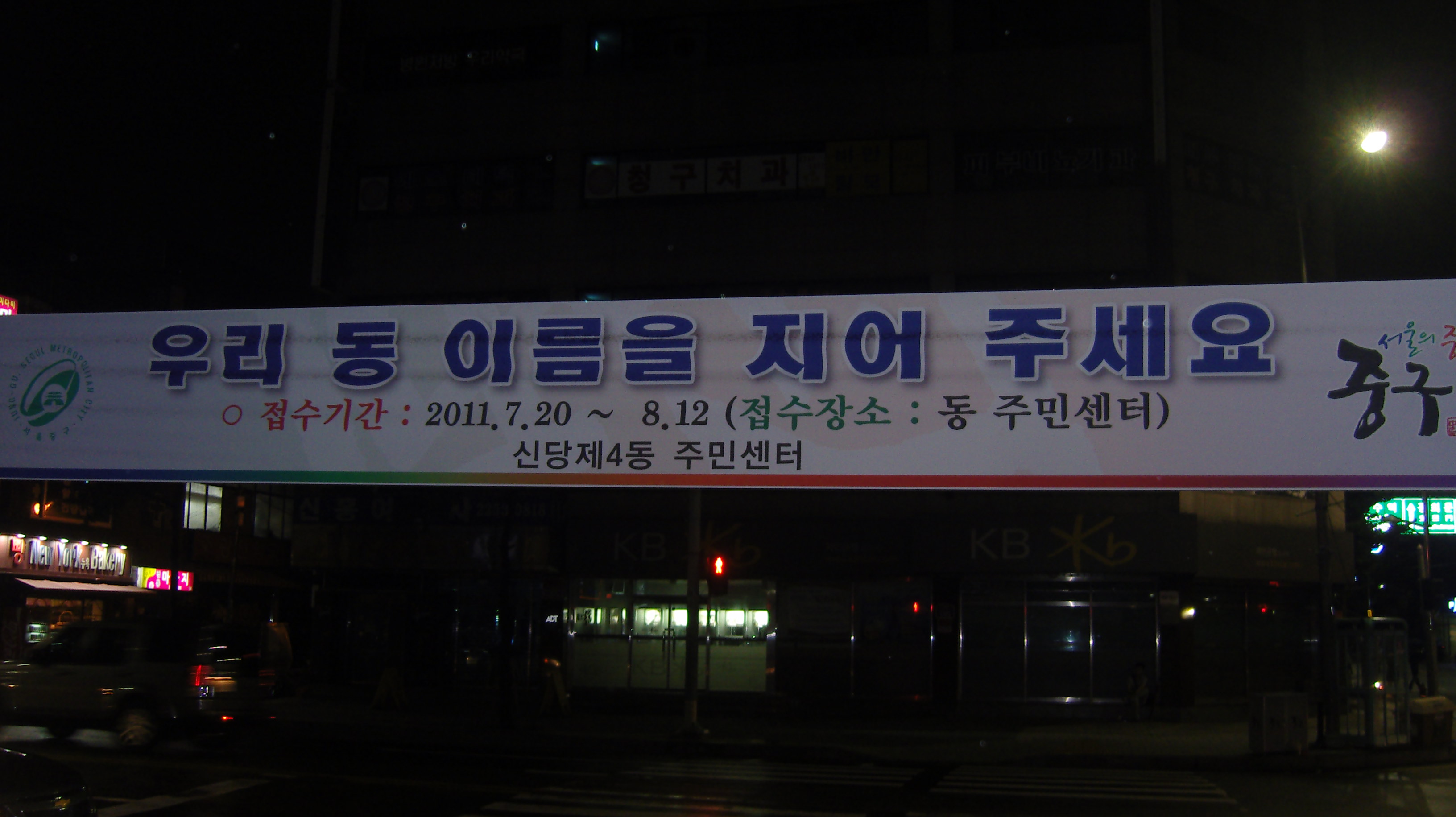
It is just an anecdote,, but it speaks volumes. Here is a call for citizens to suggest names for their neighborhood in the Jung-gu District of Seoul. I see constantly calls for contests and other opportunities for citizens to participate in the naming and the planning of the metro and the city in Seoul. How sincere all of these calls are, I cannot say, but I can say that I do not see much such calls much in the United States.
My increased collaboration with the Graduate Institute for Peace Studies at Kyung Hee University, and my work with the Global Peace Festival Foundation in planning the November Global Peace Convention in Seoul has led me to think more deeply about the term “peace” and its significance in our age.
Two things are clear:
First, “peace” is growing in influence as a critical concept for responding to the challenges of our age and an idea with immense intellectual and emotional appeal.
Second, the concept of “peace” will require a thorough redefinition in light of significant changes in human society that have taken place and the new challenges that we face. We need to build a discourse on peace that is at least as nuanced and authoritative as that used for “security,” or for that matter that used for “economics.”
The Interdisciplinary Studies Program at Humanitas College, Kyung Hee University, submitted to Seoul National University’s Advanced Institutes of Convergence Technology (AICT) a research report entitled “Strategies for Promoting Successful International Collaboration in Convergence Technologies: A Consideration of the Korean Bio-Medical Field” on September 1, 2011. This report was the culmination of Emanuel’s work over the summer including his discussions with University of Illinois, Yale University, MIT, RIKEN (Japan) and other institutes concerning effective strategies for international collaboration in convergence technology research.
The study was guided by Emanuel Pastreich, Eugene Pak, Ph.D., of SNU, AICT, and Vince Rubino of SEE GENE Incorporated. Michael Gehret, Associate Director of the Institute for Advanced Studies and Richard Herman, Chancellor Emeritus of University of Illinois, Urbana-Champaign, participated in the study.
We hope to expand the study into a long-term program for facilitating international collaboration in the near future.