The Korean Hangul script as a global phonetic system

A fascinating article by Professor Sin Buyong, Director of KAIST’s new “Hangul” Engineering Institute” in which he argues for the broad application of the Korean hangul script globally. Korea is starting to expand the concept of technology to include many new applications, and this concept of hangul as a universal script that can more accurately, and more simply, represent all languages is particularly striking.  What is new here is the Koreans are not merely proposing more people in the world should learn Korean, but also that they could better write their own languages using the hangul script.

Professor Sin presented in a previous article an input device employing hangul and demonstrates how hangul is better than the Roman script for inputting English. I am not sure how realistic this example is, but it does suggest a new self confidence and creativity which is most welcome.
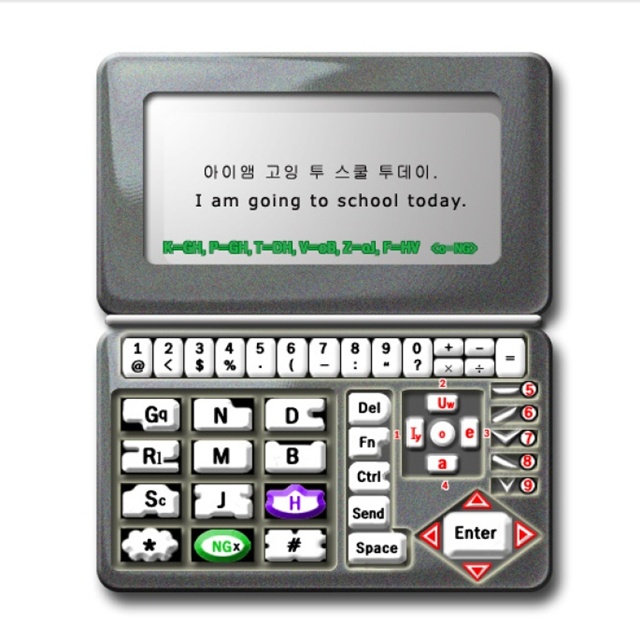
Demonstration of the greater efficiency of Hangul script over Roman script for inputting English.

“Defining Convergence” Asia Institute Seminar Featured in Korea IT Times (article)

KOREA IT TIMES

Thursday, October 20th, 2011


“Wrestling with Convergence, Part 3: Defining the Convergence of Industries”


The Asia Institute recently held a round-table discussion on the topic of technology convergence. The discussion was led by Dr. Emanuel Pastreich, Professor of Humanities at the Humanitas College of Kyung Hee University. Also in attendance were Charlie Wolf, Director at the Social Impact Assessment Center in the Greater New York City Area; Paul Callomon, Collections Manager at the Academy of Natural Sciences in the Greater Philadelphia Area; Stephanie Wan, the YGNSS Project Co-Lead and the North, Central America & Caribbean regional Coordinator of the Space Generation Advisory Council; Daniel Lafontaine, Business Coach and Consultant at AMA Korea; Alan Engel, President at Paterra, Inc. in Japan; Matthew Weigand, founder of Responsiv.asia and former editor of the Korea IT Times; Tahir Hameed, Research Fellow and PhD Candidate at Korea Advanced Institute of Science and Technology; and Vince Rubino, Global Team Leader of Business Development and AQ at the Korea Institute of Toxicology. In this third part of a five-part series, the experts discuss the true definition of the term convergence that is so easily thrown around these days.

Matthew Weigand: Personally I’ve always thought that the term Convergence was broad and generalized for political reasons – it encompasses the greatest possible meaning because people would like it to. Nailing it down to any one specific meaning would be marginalizing some segment of new technologies which want to claim the label for financial or political reasons. So I guess Emanuel’s take on breaking down convergence into sub-categories would be the only way to make any headway on discussing it.

Tahir Hameed: Thanks for a quite agreeable stance, and rightly pointing the only way forward. My intention was to just to establish a perceived weakness before carrying it on. Coming to the next question, there should be at least two aspects to discuss this; the possibility of development of S&T, innovation or industry, and the benefits that brings for society in general. There can be several issues in each. For now, I share my thinking about how the term convergence is useful to Korea in general. Will try to contribute on specifics and possible growth projections later.

Read more

The Function of Literature and the Byeung-ju Lee (이병주) International Literary Festival

Emanuel was invited as a speaker at the Byeung-ju Lee International Literary Festival in Seoul on September 29, 2011. The Festival brings together important writers and literary critics to discuss contemporary literature and its significance. Emanuel was on a panel with the Chinese novelist Dong Xi (東西) and the Japanese horror writer Kishi Yusuke (貴志祐介). We also spent a day in Hadong, at the base of Jili san Mountain. Hadong was the long term resident of Lee Byung-ju, author of many novels on the social conflicts of Korea in the 20th century.  His most famous novel Jili san is the epic of a family torn apart by ideological conflicts.

Emanuel spoke about the function of literature in contemporary society, arguing that literature is the most effective means to address social issues

Read more

Op Ed by Vice President Strobel of Yale University

Professor Scott Strobel, Vice President for West Campus at Yale University, has taken a deep interest in Korea of late. He recently wrote this very thoughtful article about Korea’s possible future role in science and technology.

KOREA IT TIMES

“Korea’s Potential in Scientific Discovery: A Strategy for Realization”

Thursday, October 6th, 2011

Scott Strobel

Vice President for West Campus

Yale University

The Growing Trend towards Asia in Science and Technology

Korea has a tremendous opportunity to play a central role in the future of discovery in science and technology if it takes advantage of some emerging trends. We can already see the growing sophistication of science in Asia in terms of the quality of its

Read more

Professor Jung Min’s Study of the awareness of a “common realm” in pre-modern East Asia

I had the opportunity to meet with Professor Jung Min (정민 교수) of Hanyang University on September 28, 2011. I have the ultimate respect for Professor Jung, one of the most careful and insightful scholars of the classical Chinese tradition in Korea. He has also worked on Park Jiwon’s writings at length and we have shared notes before. He gave me a pile of intriguing articles and books, but one article in particular seized my attention. The title is

“Awareness of a “Common Realm” among 18th and 19th Century Korean Intellectuals”

Read more

“The Intellectual ‘Korean Wave'” (知的한류) in Korean (Munhwa Ilbo 문화일보)

 文化日報

‘知的 한류’시대

이만열/경희대 후마니타스 칼리지 교수

2011년 10월 11일(火)

http://www.munhwa.com/news/view.html?no=2011101101033137191007

한류(韓流)가 세계를 휩쓸고 있다. 한국발 사랑 노래, 스릴 넘치는 영화, 시선을 떼지 못하게 하는 TV 드라마가 새로운 세대는 물론 기존 세대의 상상력까지 사로잡고 있다. 이렇듯 한류가 한국의 이름을 알리는 데 널리 공헌하고 있다지만 궁극적 의미에서 진정한 지적(知的) 한류는 아직 시작되지 않았다.
미국과 유럽, 일본에서조차 최고의 지성들이 한국의 작가 이름을 한번도 언급하지 않고, 한국 주요 지성들의 글을 읽은 적이 없으며, 한국 역사의 깊이에 대해 무지한 것이 현실이다. 버락 오바마 미국 대통령이 한국의 교육에 대해 찬사를 보낼 때조차 한국 전문가들의 이름이 언급되지는 않았다. 한국에 살면서 한국어로 된 서적과 저널을 읽고 한국의 미술관을 찾아 한국 지성들과 대화를 하는 외국인으로서 이러한 분야에서 세계에 널리 소개돼야 마땅한 부분이 많다고 단언한다.

Read more

“Convergence in Space” (article in Korea IT Times)

Recent Asia Institute Seminar on convergence and space featured in Korea IT Times.

Wrestling with Convergence, Part 2: Convergence in Space

Friday, September 30th, 2011

Logo

The Asia Institute recently held a round-table discussion on the topic of technology convergence. The discussion was led by Dr. Emanuel Pastreich, Professor of Humanities at the Humanitas College of Kyung Hee University. Also in attendance were Charlie Wolf, Director at the Social Impact Assessment Center in the Greater New York City Area; Paul Callomon, Collections Manager

Read more

Book Signing and Lecture for “Life is a Matter of Direction, Not Speed”

We will have a short lecture and book signing aimed at young people for Emanuel’s book “Life is a Matter of Direction, not Speed”

I do hope everyone can come.

Book Signing and Lecture

 출판기념회

Date:      Friday, October 21, 2011-09-28

일시 : 2011. 10. 21. (금)

Time:       2-5 PM

오후 2시~5시

Location:      The   Leader’s Club

Basement

Yangcheon-gu Minhoegwan (Citizen’s Hall)

장소 : 양천구민회관 지하 1층 리더스클럽 (양천구청역 2호선)

http://kr.gugi.yahoo.com/detail/2630598483/%EB%8B%A4%EB%AA%A9%EC%A0%81%ED%9A%8C%EA%B4%80/

Subway Line #2

Yangcheon-gu District Office

 (양천구청역 2호선

Presentation before Ahn Chul-Soo 안철수, President of SNU AICT

Emanuel made a presentation Thursday, September 21, to a director’s meeting of Seoul National University’s Advanced Institutes of Convergence Technology concerning the results of the recent research project and suggestions for future work. Professor Ahn Chul-soo (안철수 박사) recently appointed President of SNU AICT, was present for the event. Emanuel stressed the importance of international collaboration and made suggestions for increasing the international visibility of SNU AICT.

The photo from the meeting is a bit dark.

Hyungak Sunim’s introduction to my book (현각수님)

Hyungak Sunim is an American who has established himself in Korea as a Buddhist monk and thoughtful commentator on spiritual issues. It so happens that the two of us were classmates at Yale College and have communicated on various matters over the years. Hyungak Sunim lived many years in Korea and is well-known for his book about his experiences in the practice of Buddhism.

He was kind enough to write this preface for my recent book  “A Robinson Crusoe in Korea: Life is a Matter of Direction, not Speed.”

Introduction to “A Robinson Crusoe in Korea: Life is a Matter of Direction, not Speed”

By Hyon Gak Sunim

Writing in the mid-19th century, the Father of American Philosophy,

Ralph Waldo Emerson, made strong and radical attempts to unshackle

his American contemporaries from the chains of their strict,

conservative, book-only views of education. Though he himself was a

child of the ancient Greek and Roman classics, graduated from

Harvard College with a classical education, as a mature philosopher

Read more