Returning to the countryside for a brighter future

I received a letter about a month ago from a young woman who had decided to start life as a farmer in rural Korea. Although the numbers are not enormous, the return to the farm is a meaningful trend. Moreover, farming offers the greatest potential for responding to the problem of unemployment among youth. If we could break up factory farms in the United States and give the land in small grants to young people, we could greatly improve the economy and bring higher stability to society. Not to mention the fact that small farmers take better care of the land.

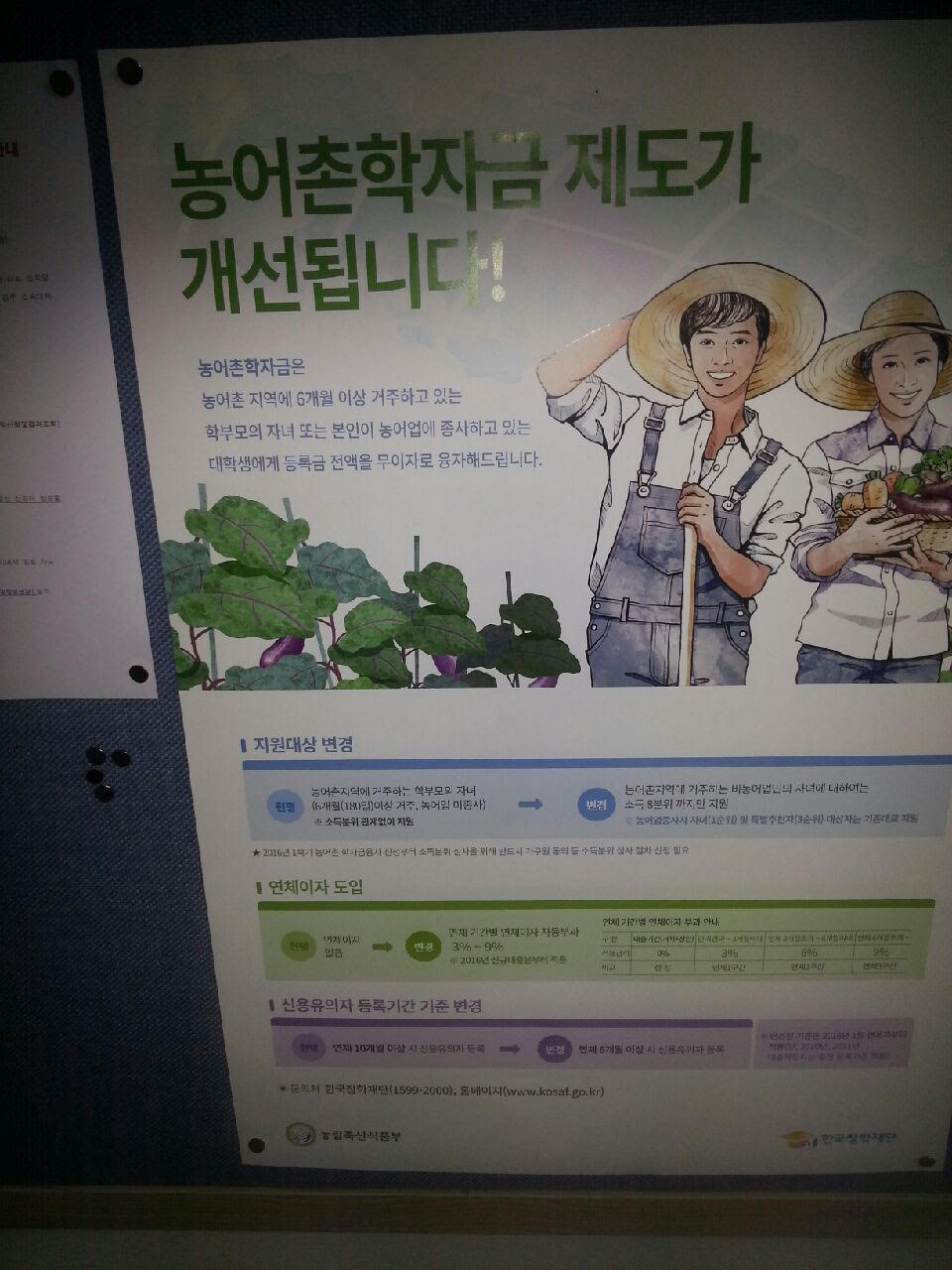
Here is an ad I saw at Kyung Hee University concerning opportunities to return to farming. The title reads “the scholarship program for rural farms and fishing villages has been improved.”

unnamed (3)

Envelope for bribes

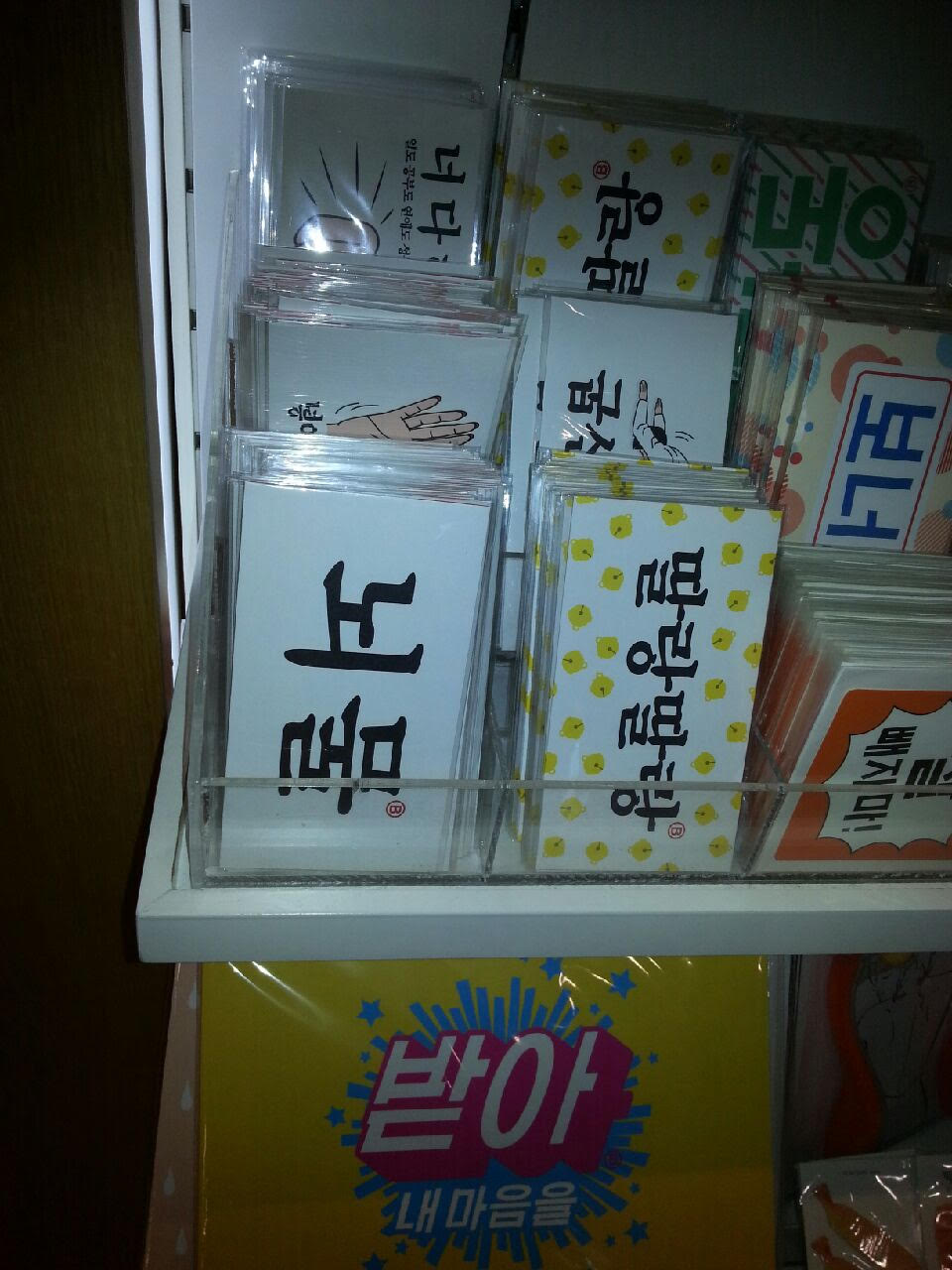
Kyobo Books in Gwanghwamun is increasingly not about books at all. The space sells everything from clothing and speakers to food and candles. But this bit of stationary caught my eye today. The envelope you might use for a end-of-the-year letter to a close associate is marked explicitly with the words “bribe!” Some distinct Korean form of humor?

unnamed (4)

“Virtue is not solitary” (Emanuel’s lecture to public officials)

“Virtue is not solitary”

My search for Korea’s future in its ancient tradition of ethical government

Emanuel Pastreich


I was rushing to a meeting around 11 AM on August 4th when a rather odd message from a friend showed up on my smart phone: “The President talked about your book!” I had no idea what the note referred to, or why President Park Geun-hye (I assumed that President Obama was unlikely to have read any of my books in Korean) would have mentioned me. It would be another two hours before I learned that President Park not only referred to my book “Another Korea That Only Koreans Don’t About” at her first cabinet meeting after her summer vacation, but that she made it the centerpiece of an argument for the next phase of her “creative economy” project, stating,

“Depending on what we do now, Korea can or cannot take the leap and become a No. 1 nation, create value in the international community and lead not only in the global economy but also in the arts and society.”

It was an honor for me to be recognized at such a high level in the Korean government and I was deeply impressed that Korea takes someone like me, a scholar of classical literature and Confucian philosophy, that seriously in the field of policy. I have always dreamed of a world in which an intellectual trained in literature could play a major role the policy debate as was the case in traditional Korea and China. Although the United States has many tremendous qualities that we still do not find in Korea, I can say definitively that it would be absolutely impossible for a scholar of classical literature to play such a role in my country.

But the most exciting result of that brief comment by President Park at the cabinet meeting was an invitation from the Minister Lee Geunmyeon, Director of the Agency of Personnel Management, to deliver a series of four lectures for high-ranking civil servants at the Central Officials Training Institute (중앙공무원교육원) starting the following week. I had delivered talks at Central Officials Training Institute, but this time was different. I was directed to talk with them about the value of Korea’s past for helping us chart a path for the future, about the deep truths to be found in the writings of scholars from past dynasties.

Read more

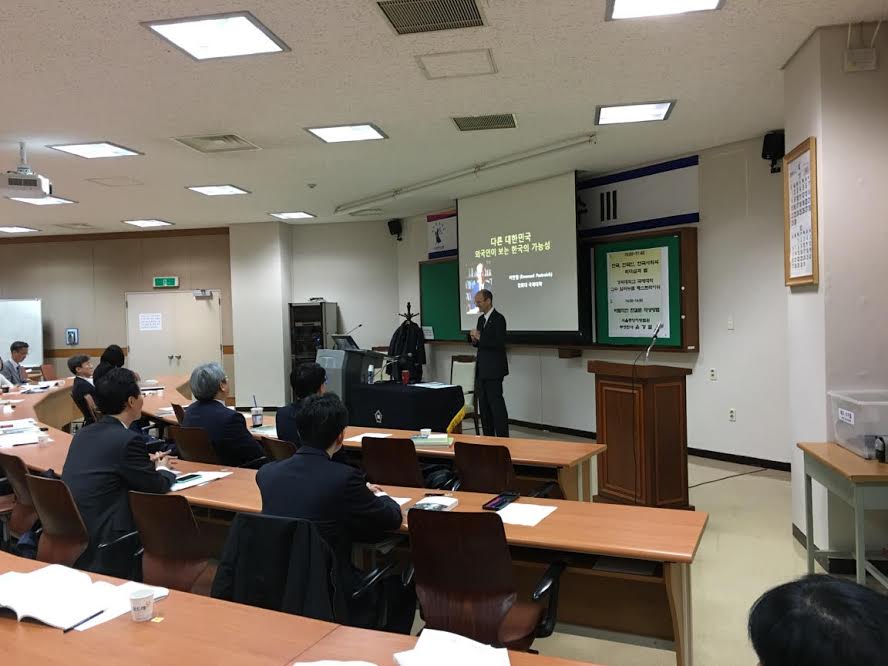
“오늘날의한국의법, 그리고미래” 사법연수원 특강


이만열 (임마누엘페스트라이쉬)

아시아인스티튜트소장

사법연수원

오늘날의한국의법, 그리고미래”

2015.11.11


58fde82e-fc75-45ff-abb1-9ee639b39fb9


전철 삼호선을 타고 멀리 북쪽으로 계속 가서 한번도 가본 적도 없는 마두역 에 내렸어요.

맑은 가을 날 아침, 지하철역에서 사법연수원으로 걸어가는 길은 즐거웠다.  한국과 세계가 머지 않아 넘어서야 하는 여러가지 도전들에 대한 나의 생각을, 판사들에게 솔직하게 이야기할 수 있는 이 귀한 기회에 나는 크게 흥분이 되어 있는 상태였다.

사실 강연에 대한 초안을 작성하기 전에는 판사들에게 강연을 한다는 사실의 중요성에 대해 깊게 생각해보지 않았었다. 그러나 강연 준비에 본격적으로 착수하면서 작년에 돌아가신 나의 이모 Jeanne Rouff에 대한 생각을 멈출 수 없었다.

Jeanne Rouff는, 우리 어머니의 언니이다. 그녀는 Luxembourg에서만 평생을 일했었다. 미국으로 유학을 떠난 후 고국으로 다시 돌아가지 않았던 우리 어머니와 달리 Jeanne은  영어에는  재능이 없었다.  Jeanne 이모는 룩셈부르크의 첫 여성 변호사이자 판사, 그리고 첫 여성 대법관이었다.

Jeanne 이모의 지적인 업무와 일에 대한 열정의 깊이는 항상 어린 나에게 가장 큰 영감의 원천이 되었다. 나는 항상 커서 그녀처럼 되고 싶었다.  언젠가 룩셈부르크의 숲속에 위치한 회색 치장벽을 가진 그녀의 집에 방문했었을 때, 검토 중에 있는 사건 파일들과 놀라운 책들이쌓여있던, 윤광이 나는 긴 나무 책상이 있는 서재를 나는 지금도 잊을 수 없다. 나도 그녀처럼 법을 해석하고 정책을 결정하는 사람이 되고 싶었다. 나는 뭔가 크고 중요한 일을 하고 싶었다.

Read more

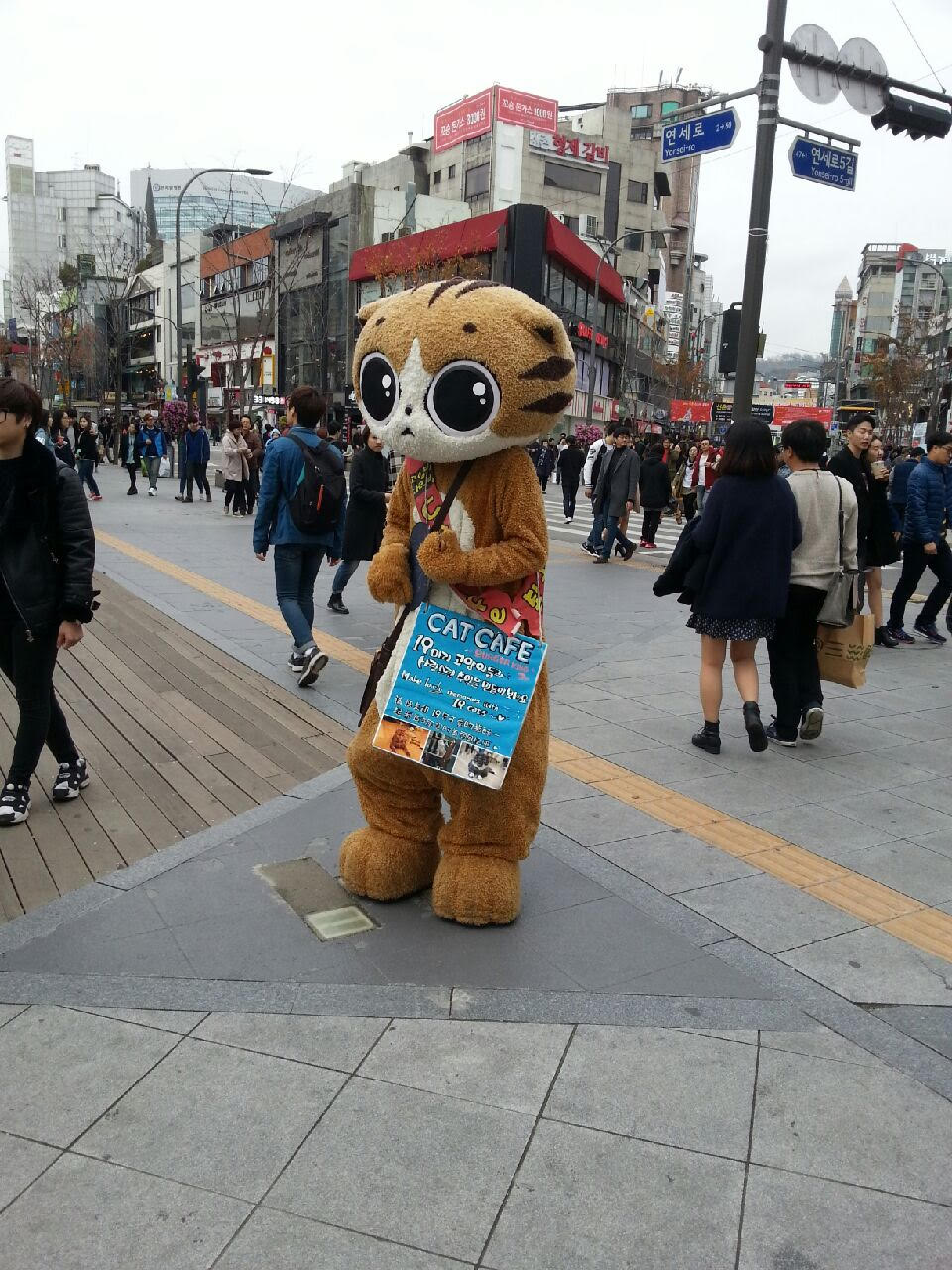
The Cat Cafe in Sinchon

A remarkable cafe has opened in Sinchon, just a few minutes away from the gates of Yonsei University. This “Cat Cafe” is inhabited by 19 cats who walk back and forth between the adoring customers, and also climb up the elaborate cat structures that run along the walls and the ceiling of the large room.


I had heard rumors about the Cat Cafe previously, but only stumbled upon it when I met someone dressed up in a cat outfit walking along the street nearby.


cat cafe


The Cat Cafe is extremely popular with young Korean girls, but it is also increasingly frequented by Chinese tourists. The staff is deeply attached to the nineteen resident cats and they are happy to relate tales about the cat fights and the rankings of the cats in the hierarchy.

Read more

“Flying Snow” and the tragedy of the April 3 Incident in Jeju

I visited the Jeju 4.3 Peace Park recently during a seminar about the April 3 incident that I attended on Jeju Island (October 30, 2015).

The monuments in the peace park are extremely subtle, but grow upon one over time. I would say you must spend at least an hour walking among the spaces there before you start to appreciate the symbolic power of the grey stones and solid masses that are placed in the midst of green rolling grass.

I knew a few details about the killing of tens of thousands of people on Jeju Island starting on April 3, 1948, and how the incident was actively suppressed for decades in Korea. But I had never spent any time thinking deeply about the significance of that event for Korea, and specifically the psychology required to keep killing people for weeks and months, not just for a few hours of rage. I do not think that I understand that psychology yet, but I do feel strongly that the first lesson about the 4.3 incident has something to do with human nature itself.

I was deeply impressed by the sculptures at the 4.1 Peace Park and I feel that unlike many modern monuments that abound in Seoul, this one will survive the test of time.

There was one work that I thought was haunting that was entitled “flying snow” (飛雪). It is built on the exact spot that a young woman by the name of Byeon Byeongsaeng (변병생), 25 years old at the time, was shot in the back during the counterinsurgency operation by police sent down from Seoul. Byeon Byeongsaeng was hugging her baby daughter when she was shot by the officers chasing her and fell over into the snow and froze there.  

Read more

“The value of the Korean language” (JoongAng Daily October 12, 2015)

JoongAng Daily

“The value of the Korean language”

October 12, 2015

Emanuel Pastreich


http://koreajoongangdaily.joins.com/news/article/article.aspx?aid=3010206


I must admit that it is easier for me to prepare for my classes at the college of international studies of Kyung Hee University. It was time-consuming and sometimes humiliating to prepare and teach classes in Korean when I taught at the Hoegi-dong campus. To be honest, although I can read and write Korean, my pronunciation is simply not that good because I started studying Korean at the age of 31. Now, teaching in English, I manage to inspire a lively discussion, granted that there are some students who have trouble following in English.

When I started working with international students more closely, I discovered that most of them have little or no foundations in Korean, and they cannot read original materials or pursue any meaningful independent research using Korean sources. The university assumes that it is natural for international students to simply do all their coursework in English, but I know for a fact that students who do not have Korean language skills face a significant disadvantage finding jobs in Korea after graduation because of their lack of language skills.

In my case, I learned to read and write Japanese with considerable sophistication as a graduate student in Japan back in the 1990s. I completed all of my courses in Japanese and wrote a master’s thesis in Japanese. Although I was not fluent in Japanese when I started graduate school in comparative literature at the University of Tokyo, I was forced to increase my proficiency very quickly under the tremendous pressure of doing 20 to 100 pages of readings in Japanese every day. That trial by fire made my career, setting me apart from the vast majority of Americans who learn a smattering of Japanese conversation during their stay in Japan.

Foreign students at Kyung Hee are missing out on a tremendous amount because they never received rigorous training in Korean in college – in fact, advanced Korean is not even required for graduation from the international college. There is no expectation in Korea that they learn Korean at all, let alone master it.

Read more

“Women and Confucian Thinking” (JoongAng Daily September 25, 2015)

JoongAng Daily

“Women and Confucian Thinking”

September 25, 2015

Emanuel Pastreich

I cannot stand to take my daughter to the subway stations Sinsa or Apgucheong these days. It just sickens me to have to walk with her, a young and impressionable girl, past dozens of advertisements for plastic surgery clinics showing women posing in a sexually suggestive manner. The assumption that somehow women must be physically attractive in order to be successful, and must surgically change their appearance to do so, damages young women from an early age.

But the problem goes further than that. This country is increasingly run by women, ?and women will play an even greater role in the future. But if those women think their primary concern should be the shape of their body, rather than their commitment to being informed and active citizens, the cost will be tremendous.

This focus on physical appearances in Korea has reached a dangerous extreme. Twenty years ago, I felt that Japan rather than Korea, put an unnatural emphasis on women’s physical features, but today it is the complete opposite and even more women are feeling pressured to go under the knife. And there are even some who argue that plastic surgery is a “growth industry” that can bring in tourism yuan.

The time has come for us to put our collective foot down and declare that this trend, with its dangerous implications of cultural decadence, should end.

Advertising for non-essential plastic surgery should be prohibited and steps should be taken to restrict this technology to those who actually require reconstructive surgery. It is unfortunate such a move may impact on some parts of the economy, but a healthy moral environment should take precedent. 

Read more