I was invited to a meeting with a certain governor last month at which a group of experts discussed the province’s efforts to develop technology. The group assembled around a vast table spoke at great length about biotechnology and nanotechnology and unveiled their plans to encourage start-up firms.
But in the midst of all that pie-in-the-sky talk, I could not stop looking at the snacks that were offered up for us to eat.
In front of each person at the meeting stood a plastic bowl piled high with chocolates, cookies and candies, all covered in brightly colored plastic wrapping. There was absolutely nothing that I was tempted to eat.
That was not all. Although the entire event was a promotion for the province, there was not a single product among those snacks that was actually produced there.
I have no doubt that if asked, the participants at the meeting would have much preferred a snack made from the fruits or grains of the region, something with some distinctive flavors that would affirm that this province had its own traditions and cuisine. I know that Korea has a wide range of traditional crackers, dried fruits, cakes and nuts that would have been perfect for a snack and that would have also supported the local farmers.
But after some eight years working with local government in Korea I can say with confidence that it is rare that local foods find their way through the barriers of logistics to actually make it to the table for such events. In fact, the food you get in the governor’s office is more likely to be the product of a big food producer rather than a local supplier.
But the problem is more one of what is provided, rather than by whom. I have found, increasingly, that every time I enter a convenience store I am confronted with shelves lined with processed foods: chocolate bars, potato chips, crackers and instant ramen high in sodium and saturated fat. None of these choices offers nutritional value and there are rarely any vegetables or fruits to be found.
Our youth are exposed to processed foods, and even encouraged to eat them, without any awareness of the negative impact they will have on their health. Those products are not food at all, and do not compare with the nutritious foodstuffs produced by local farmers. Many medical experts recommend against such processed foods in light of increasing evidence of linkage of foods high in sugar with diabetes and even Alzheimer’s disease. We can already see the results of diets based on high sugar content. According to materials released by the National Health Insurance Service, the number of people under 18 receiving treatment for diabetes has increased by 31 percent over the last decade. According to an study the number of obese Koreans was 4.2 percent of the entire population in 2012, up from 2.5 percent in 2002.
During a recent trip to Japan I was impressed by how much more fresh fruits and vegetables were available at convenience stores — often supplied by local farms. Korea can do better and provide our citizens with truly healthy meals based on Korea’s long tradition of nutritious food. Moreover, requiring that the food available at local convenience stores be produced organically and locally is a good way to assure healthy diets and stimulate the local economy.
What is food? To start with, it is not something you make in a manner that encourages people to buy more of it regardless of its lack of nutritious value. Making sure that food is healthy, and teaching citizens good eating habits, is much more important than building yet another skyscraper or launching the latest smart phone.
The health of our children is as important as anything and we cannot sacrifice it for any short term profit to be derived from encouraging impulsive eating. If anything, we should encourage people to eat slowly and show appreciation for the farmers who produce our food, for the earth that nourishes us, and for the need for a constant harmony between the world of man and of nature.
Although it may offend the sensitivities of some, I think that the government has the right, and the responsibility, to step in and to regulate what food is available to our citizens so as to assure that it is healthy. It is entirely appropriate for the government to set regulations that limit the amount of processed food that is displayed in front of inexperienced young people, and set standards for what kinds of products are available. If it is not food, it should not be getting undue attention.
I hear all the time that food is the most important part of Korean culture, but I fear we are letting that treasure slip away.
by
Asia Institute Seminar:
“HISTORY, MEMORY AND THE PROMISE OF PEACE IN NORTHEAST ASIA”
Hope Elizabeth May & Emanuel Pastreich
This seminar held on November 23, 2016, traces the ties between Korea and the struggle for world peace and suggests that Korea has in its past the potential to be a leader in the current effort to “wage peace” in the face of increased tensions around the world.
(From Asia Today)
The Asia Institute held a seminar on “History, Memory and Peace in Northeast Asia”on November 23 with Professor Hope Elizabeth May, Professor of Philosophy at Central Michigan University. Professor May discussed the 19th century international Peace through Law Movement (which predated the UN and the League of Nations) and to which the Korean Independence Movement repeatedly appealed. The event drew reporters, diplomats, academics and young students interested in new approaches to peace in East Asia.
The relationship of the United Nations to Korea is normally assumed to begin with the Korean war, but this seminar showed the link between Korean independence and the campaign for world peace and international arbitration which took off in the late nineteenth century, culminated in the Hague Conferences, and produced the United Nations.
Professor May described how the drive for Korean independence was linked to the advocacy for world peace by the Korean delegation sent by Emperor Kojong to the Second International Peace Conference in 1907. This mission, led by the American Homer Hulbert and the Korean loyalist Yi Jun, made a rational argument for the Korean independence as part of a larger embrace of peace.
Professor May discussed how members of international civil society sympathized with the Koreans and gave them a voice at the meeting.
A peaceful approach to the resolution of conflict was at the heart of 1919 Korean independence movement whose Korean Declaration of Independence advocated the avoidance of anger and resentment:
“We have no wish to find special fault with Japan’s lack of fairness or her contempt of our civilization and the principles on which her state rests.”
Professor May placed current efforts for peace in the context of “Peace History,” a “red thread” that ties together today’s movements to previous efforts over the last hundred years. She suggested that we must embrace this “positive history” if we want to move beyond the remarkably disturbing descriptions of Korea’s history that focus on massacres and “atrocity history.”
May argued that this history contains reservoirs of inspiration and “moral energy” that can link us to the community of individuals, past, present and future, who strive for a more harmonious world.
She closed with a quote by Soviet dissident Natan Sharanksy, which helps us to understand how ‘positive history’is a treasure trove of moral resources:
Souls interact across time and space. The decisions people make in a difficult hour, the principles they either abide by or abandon in moments of truth, have consequences not just for their own lives, but well beyond.
Pastreich noted that the history of peace in East Asia could bring new potentials to future discussions about Asia’s future precisely because our vision has become so very limited by a debate in think tanks that offers the choice between military containment and economic integration that is posited on exploiting North Korea’s natural resources and cheap labor.
He suggested that this positive history of peace in Korea suggests that it is possible to present a different model for Korea that draws on the spiritual depth and moral energy of the Korean Independence Movement, and not on a consumer-based economic development model.
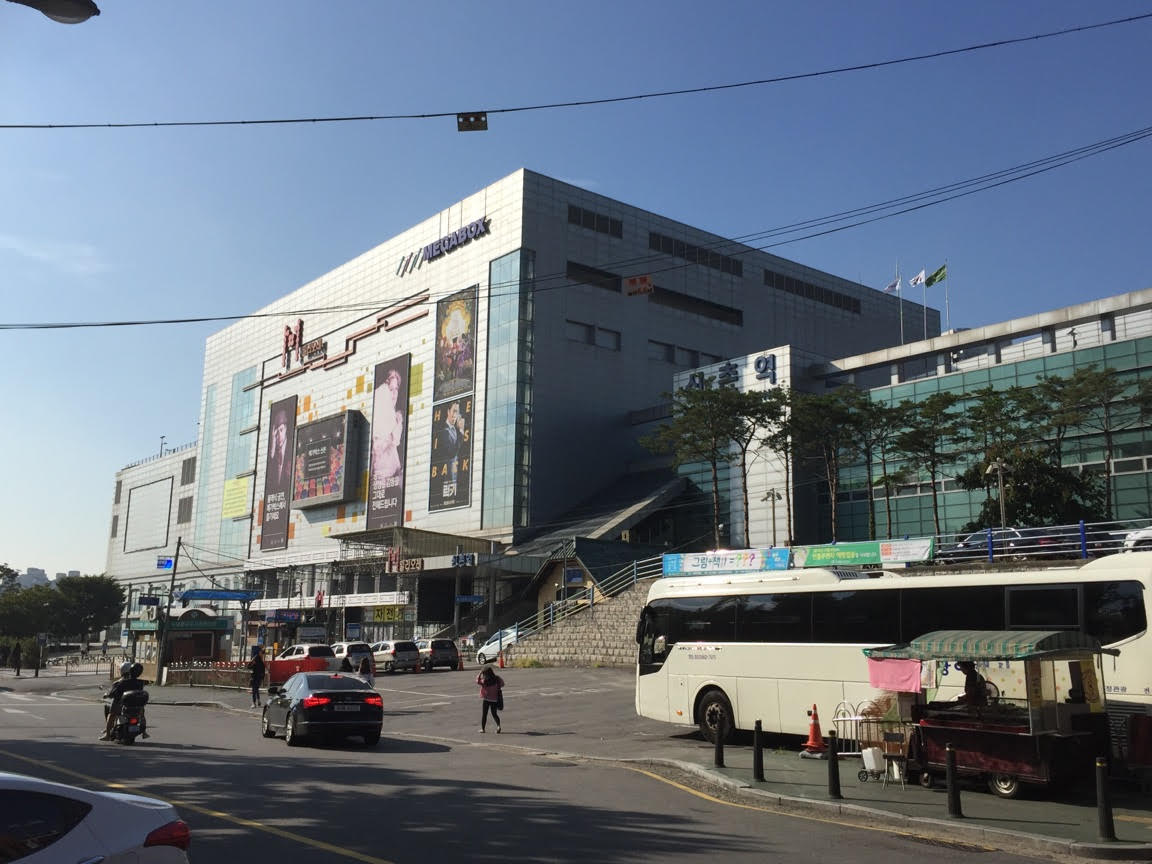
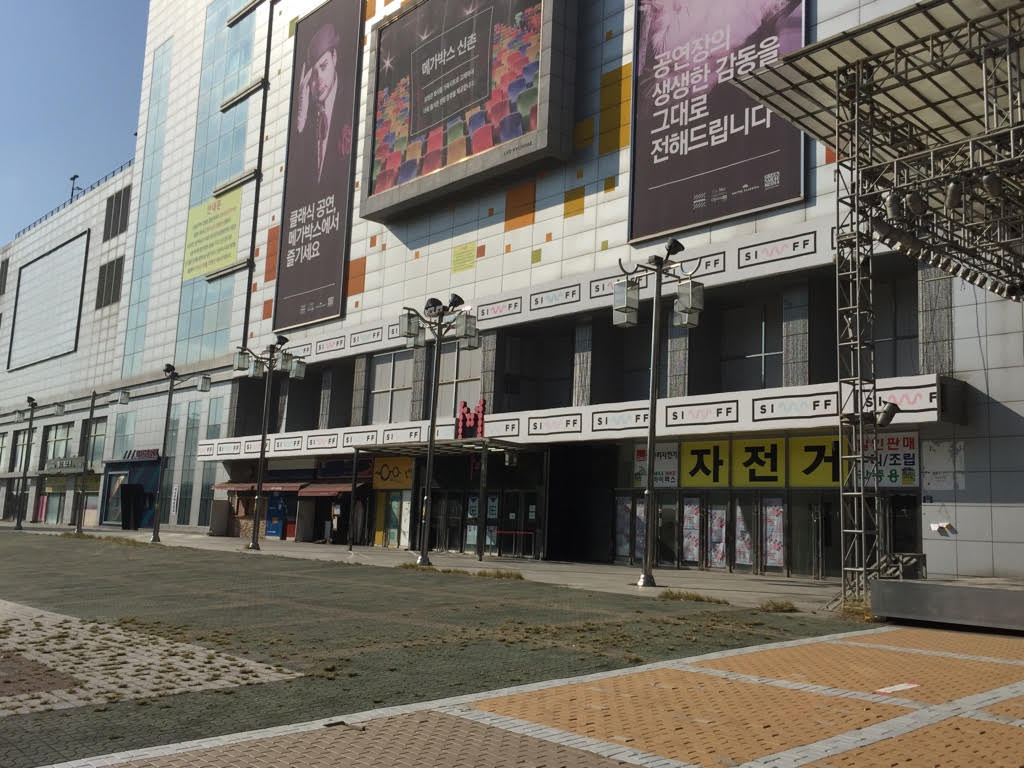
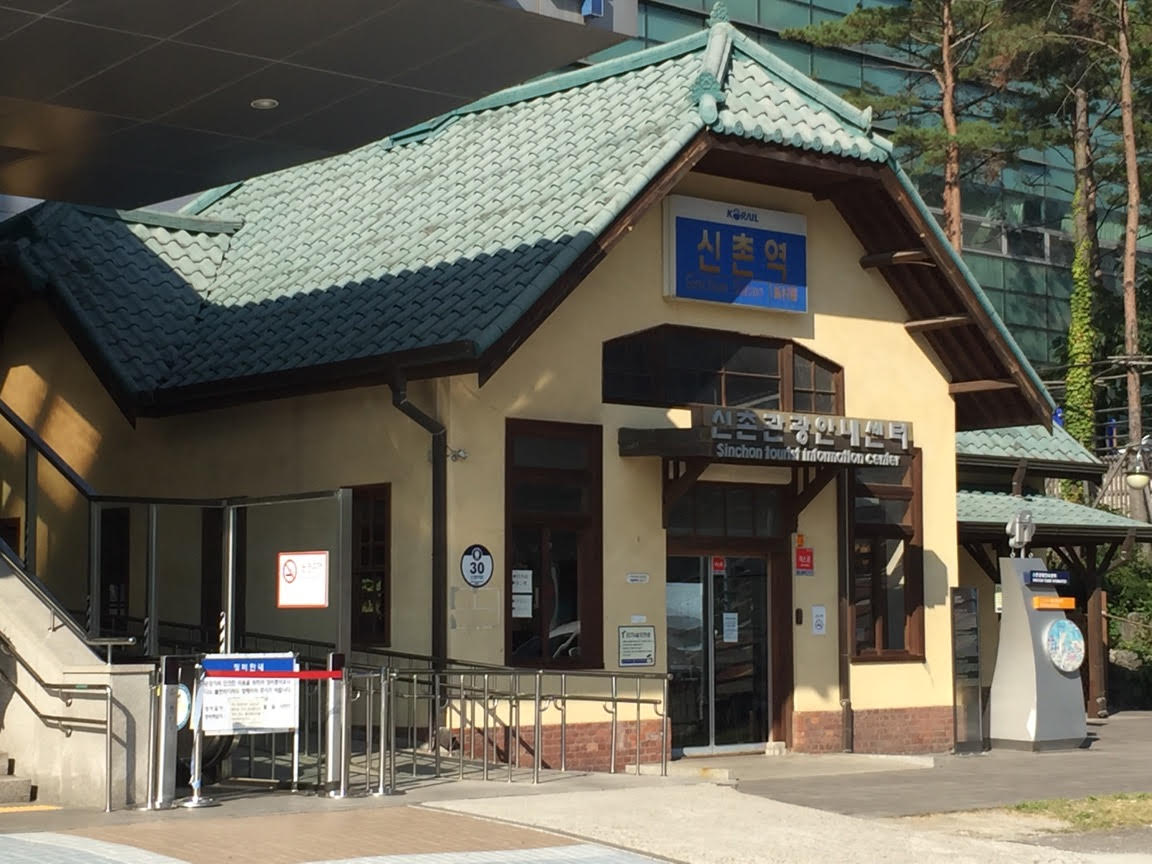
The old Sinchon Station is visible in the midst of the overbuilt development that makes up the new Sinchon station.The new shopping is center has essentially closed down, whether awaiting redevelopment or something else.The quaint Sinchon station now exists as a center for tourism information.
One of the saddest aspects of contemporary Korean culture is the emphasis on false monumentality.
The assumption among many Koreans, and especially city planners, that large and impressive structures create a modern, and therefore more enjoyable and more livable, environment.
Nowhere is this tragedy more apparent than at the Sinchon station near Yonsei University. The has been built up into an enormous shopping center, but there is almost no business and the building was so poorly constructed that it has been shut down for repairs. The assumption was that somehow through this massive over-development the neighborhood would be improved. But the simple original Shinchon Station remains as a contrast. This handsome building is more than sufficient as a station and with a bit of modification could still be employed today.
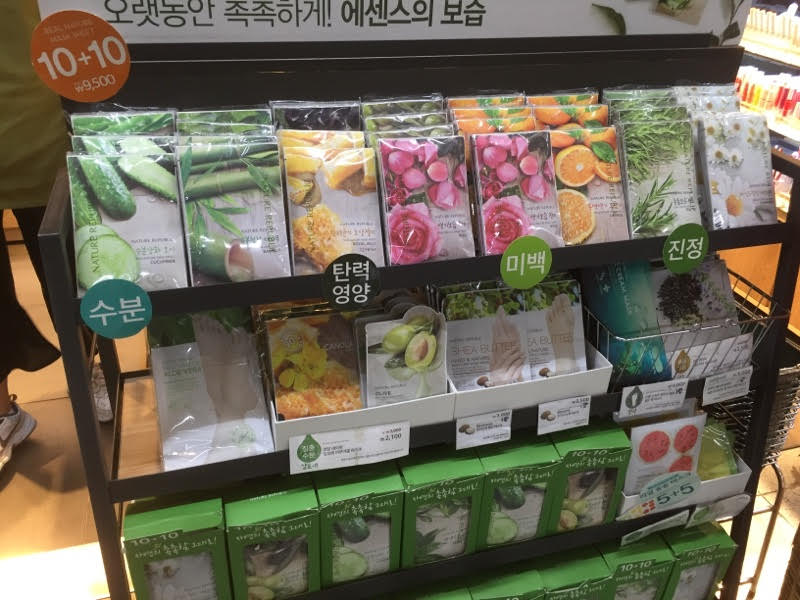
I do not know when it started, but all the cosmetics stores in Korea are filled with creams and cleansers for the skin that are made from foodstuffs. I find it one of the most bizarre trends. Somehow it would seem that if foodstuff is good for your skin, you could just make the lotions yourself.
food for skin?
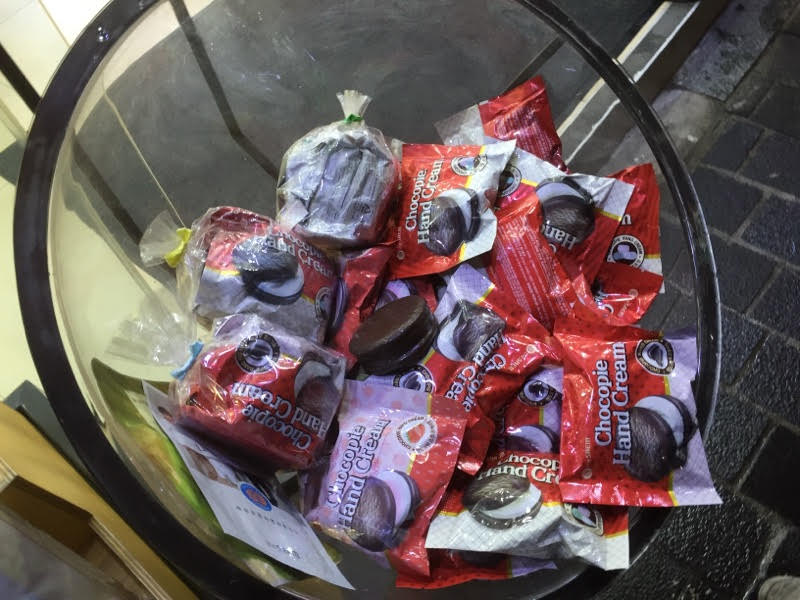
But the recent release of Chocopie Hand Cream based on the world- famous Korean Chocopie cookie takes the cake. I assume these are aimed at Chinese tourists, but honestly I cannot imagine who would buy them.
Never thought that the Chocopie was good for much of anything healthy.
Take a look. Better yet, try one and let me know if it helped your skin problems.
There I was standing in the stationary store the other day, lined up to purchase pens, pencils and some printer paper before the start of classes. When I reached the counter, I was struck by a gaudy stack of candy bars and other sweet treats. But this is a stationary store, I thought, why am I seeing all these unhealthy snacks?
The answer is obvious: the candy bars are placed in the most visible place, even though they have nothing do to with stationary supplies, because retailers hope that customers will impulsively buy them even though they have no need for them, and they are not nutritious.
You would never have found candy bars piled up in a stationary store in Korea 15 years ago. Back then stationary stores had a clear purpose of supplying people with the paper and pens that they needed to conduct their business, or to pursue their studies.
All that has changed forever. Stationary stores are about tempting people to buy things that they do not need, and that impulsive behavior is considered essential to successful business.
The same principle holds true in bookstores. Once places where students burrowed away to read books about politics, literature and philosophy, now the books are being replaced by stuffed animals, backpacks and trivial accessories.
And every restaurant hangs a sign in front featuring glowing photographs of tasty foods designed to appeal to casual pedestrian’s cravings.
We have adopted a new normal, the assumption that the economy should be focused not on what people need, nor on what is good for our society, but rather on making money persuading people to buy impulsively through an appeal to their most base desires, without a concern for whether the purchase is necessary.
The dangers that result from making impulse and short-term satisfaction the driving force for the economy are tremendous. Human activity has no greater meaning than satisfying base cravings and imagined needs. The citizen becomes a consumer who has no higher ethical purpose for his actions; there is no longer a greater national plan than to consume without thinking about the future, and thereby to generate profits.
Such an approach to economics is alien to Korean culture. The central values of Korea are restraint, humility and an understated self-control in dress and in daily life. Such a culture of restraint extended even to the well-off families who lived in relatively modest homes in traditional Korea (certainly compared with the chateaus and town houses of their peers in Europe).
Thrifty Koreans valued every single grain of rice and threw nothing away. It was the simple and unadorned worth of simple objects that was central to Korean aesthetics.
The tragedy of an economy of impulse is not just the needless waste, but rather the loss of any sense of “why” in the lives of people. They just do things because others do so, they are consumers, but not citizens or family members. For that matter, the understanding of causality will ultimately break down, with people feeling that events simply happen without any relationship to their own actions.
Many young people are pushed to consume, but they do not know why they do so. They feel compelled to engage in such behavior because of social pressure, or because of marketing, but they derive no satisfaction for it. The individual feels increasingly alone, without meaningful friends or meaningful possessions.
There is a darker implication of an economy based on impulse. It encourages cultural decadence, a decadence that creeps into all aspects of society, conservative and liberal, and eats away at the ability of individuals to determine right and wrong, to conceive of a better society or make moral judgment.
As we lose the ability to think for ourselves, to control our own actions and to articulate a response to serious social problems, we cease to be members of a society.
A generation of Koreans raised to think that impulsive actions are a positive will not have the patience or the self-control to wrestle with contradictory facts or separate complex truths from convenient fictions. We risk losing the ability to imagine a future for our society and to work actively for that goal. Indulgence will lead us into fatal passivity, and we will find ourselves dragged along by developments that are beyond our capacity to understand.