“The day after the removal” (JoongAng Daily March 15, 2017)

JoongAng Daily

“The day after the removal”

March 15, 2017

Emanuel Pastreich


The protests on the day after President Park’s impeachment took the most disturbing form. A large crowd gathered in Gwanghwamun Square to celebrate the unanimous decision for impeachment of the constitutional court. The protest resembled a carnival of celebration, but there were those who actively promoting other issues like the release of the black list, the removal of the Terminal High Altitude Area Defense (Thaad) antimissile system, the rejection of nuclear power and demands for more profound changes in Korean society. For them, impeachment is merely the first step in a more profound political transformation.

There was a line of police buses that blocked the boulevard. This time the police buses were not keeping protesters away from the Blue House, but rather separating the anti-Park protesters from a group of pro-Park protesters who gathered around city hall with their Korean flags (and some American flags) who were led on by rousing speeches in defense of President Park against what they perceive as a political vendetta by an irresponsible group who wish to lead the country astray.

The division of downtown Seoul into East and West reveals more profound fragmentation in Korean society, resulting in part from the growth of a superannuated society which produces a deep gulf in the basic assumptions about how the nation should be run. There are now unresolvable gaps in terms of what is assumed to be true concerning such incidents as the sinking of the Sewol Ferry, the actions of President Park and the imprisonment of the leftist politician Lee Seok-gi.
Read more

Digital Times “Because this year forms the close of a long-term cycle, we need political innovation and participatory politics”

The Digital Times

“Because this year forms the close of a long-term cycle, we need political innovation and participatory politics”

Ye Jeen Soo   

2017-03-02 10:29:49

■ 2017 Restart Korea

Insights into deep-rooted problems in the Korean economy by foreign experts

Interview with Emanuel Pastreich

professor at Kyunghee University’s International Graduate School

Emanuel Pastreich (Korean name, Lee Man-Yeol • 53) Professor at Kyunghee University’s College of International Studies is a scholar who knows Korea better than Koreans. When we asked about problems in Korean education, he spoke of the strengths of traditional Korean education, strengths found in the remarkable spirit of the ethical Korean scholar (seonbi) and the traditional spirit of community. Pastreich majored in classical Chinese literature at Yale University and received a master`s degree from University of Tokyo and a doctoral degree from Harvard University. Considered an outstanding scholar, he speaks Korean, Chinese and Japanese fluently. Little things like the kindness he demonstrated when to female employee who brought the coffee revealed that he has much internalized that traditional Korean tradition of courtesy.

We asked him about direction of Korea after the political disruption of the presidential impeachment trial when he visited the Digital Times on February 23.

Read more

“Seoul should be unpredictable” Febuary 20, 2017)

JoongAng Daily

“Seoul should be unpredictable”

Febuary 20, 2017

Emanuel Pastreich


The recent meeting between Shinzo Abe and Donald Trump was a farce. Both men were clearly complete strangers with no common interests other than to push for their own domestic agendas. Anyone watching their forced actions could see that it was a marriage of convenience.

Both politicians make good use of “political unpredictability.” Abe has abandoned Japan’s long commitment to peace as a goal and is moving quickly away from its social welfare system that was so impressive to us in the 1980s. Trump has not only abandoned the free trade stance which was the core of U.S. policy since the Second World War — without even bothering to ask Congress to pass the laws necessary, he is taking steps domestically, such as personal attacks on judges, that undermine the rule of law.

Of course, North Korea’s development of nuclear weapons and advanced missile technology is profoundly destabilizing and dangerous. Yet the odds of the North actually using nuclear weapons against the South or the United States is extremely low. Rather the risk is that continued development of nuclear weapons will set off an arms race in the region which will end up creating tensions not only with Pyongyang, but between all the nations of the region, and that process, unchecked, could end in nuclear war.

I would like to suggest that Seoul engage in its own version of “unpredictability” by doing something that no one ever guessed it would do: tell the truth.

Not only should Seoul state bluntly that the greatest danger of the North’s nuclear program is its risk of triggering an arms race. It should call on the United States to engage in serious negotiations with the North, China and Russia to create an environment in which we can reasonably expect that the North will first stop testing nuclear weapons and then take steps to eliminate those weapons.

Read more

“Letter to Ban Ki-Moon from the midst of the gathering darkness” (Kyunghyang Shinmun January 26, 2017)

 Kyunghyang Shinmun

“Letter to Ban Ki-Moon from the midst of the gathering darkness”

January 26, 2017


Emanuel Pastreich

I know that many have approached you about the possibility of your serving as president of Korea after the anticipated impeachment of President Park. You have a unique set of skills and a broad range of friends in the international community that would serve you well. Today, you are surrounded by people asking for your help in this moment of tremendous uncertainty in Korea. But I hope that you have a moment to step back from the crowd and contemplate your role in history now that you have become such a critical figure.

There are several people out there who are entirely capable of serving as the president of the Republic of Korea. But there is an even more critical job, and you are the only one who is qualified to play that role as the former Secretary General of the United Nations.

Last week Donald Trump was sworn in as the president of the United States, someone who has openly opposed a commitment to universal standards on human rights and who has taken as a central advisor John Bolton, a man who is committed to taking the entire United Nations system apart. In addition, President Trump has nominated for secretary of state Rex Tillerton,  the former CEO of EXXON, , a man who has no interest in the response to climate change and who has advocated that the United States move to stop all Chinese actions in the South China Seas—an act that many experts think could lead to nuclear war.

The scale of the geopolitical crisis today cannot be overstated and Korea, located at the center of Northeast Asia, with close ties to both the United States and to China, will be one of the first victims of such a new cold war, or hot war. Korea needs you, and your network, to start an entirely original and powerful initiative that will offer an alternative to military conflict, get the focus back to climate change, and set the foundations for long term solution to address this crisis head using a coalition of the committed throughout the region.

Read more

Asia Today

The Korea that can say “No”

 January 27, 2017

Emanuel Pastreich


Back in the 1989 the Japanese conservative politician Ishihara Shintaro wrote a best seller entitled The Japan that can say “No” in which he argued that Japan was punching beneath its weight. He imagined a self-confident Japan that was capable of refusing unreasonable demands from the United States and maintained a healthy equal relationship.

Ishihara is a cynical right-wing politician, but there is something of real relevance for the Republic of Korea today in his words.

The rise of the Trump administration means that Korea must be able to say “no.”

Members of Trump administration has made hostile statements about China that are so out of line with American policy, and so provocative, that Korea cannot have anything to do with its actions.

Read more

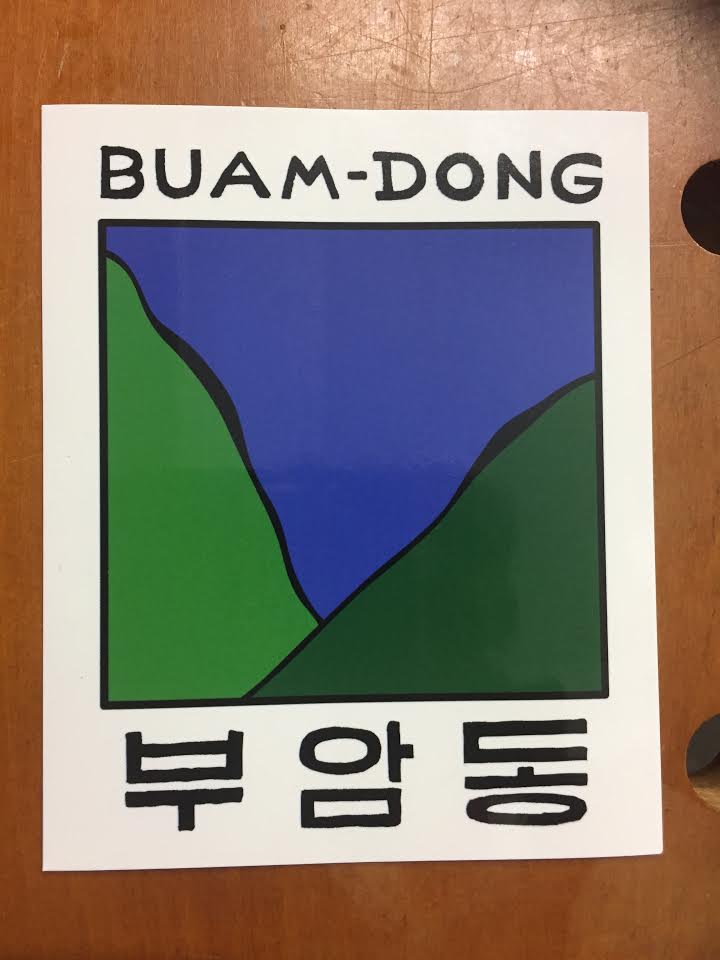
Buam-dong sticker for sale

My design for a sticker for my neighborhood Buam-dong (부암동) has been completed and is now available for 500 Won. Buam-dong is named for a cliff which was attributed with spiritual powers where those seeking help would paste magic spells written on paper. “Buam” meaning “a boulder on which paper has been pasted.”  The area was popular for excursions by the yangban from the 19th century and  the powerful politician Hongseun Daewongun 흥선대원군  built his residence here Seokpajeong (석파정). The logo can be interpreted as the meeting of Inwang Mountain and Bukgak Mountain, but there are several other locations where a similar valley is found in Buam-dong.


The final graphics were done by Kim Ki-do 김기도.

logo-final


“Words of Warning and Encouragement to South Korean Student Protesters” (Foreign Policy in Focus January 9, 2017)

Foreign Policy in Focus

“Words of Warning and Encouragement to South Korean Student Protestors”

January 9, 2017

Emanuel Pastreich

(with Ku Yae-lin)

Dear Student Protesters:

We are deeply inspired to see all of you – college students, high school students, and even middle school students – gathered in Gwanghwamun Square in Seoul, candles in hands, waving your hand-crafted posters. It is a noble action for the citizen to take to the street and demand the rule of law and insist on accountability. That so many young people have taken to the streets suggests an awaking of political consciousness in Korea that is heartening.

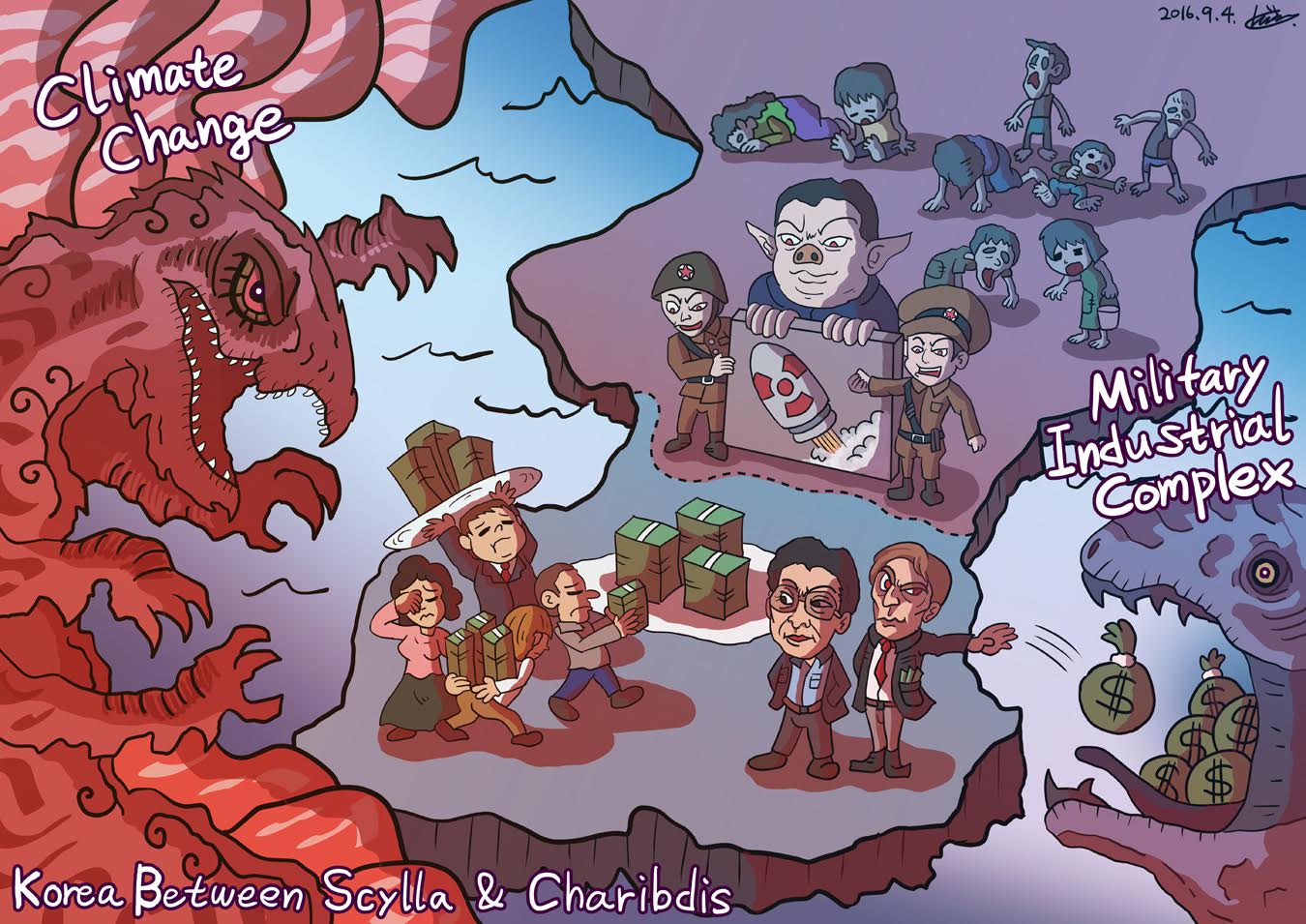
climate-change-and-mic

The media has praised you for the peaceful manner by which you have carried out your protests, going as far as to suggest that Korea is now a model for democracy.

But do not assume that this ordeal is over now that prosecutors are grilling President Park Geun-hye’s buddies like Choi Soon-sil in the impeachment proceedings.

It is entirely possible that this ordeal is only beginning.

Learning from History 

It is critical that you remember the last time that a Korean president resigned –on April 26, 1960. Rhee Syng-man was forced to step down as president of the Republic of Korea after massive strikes by students, joined by concerned citizens. The students rejoiced in their victory and imagined that a democratic government would soon be set up. But for all of their bravery, the students who led those protests had few connections within government and no solid plans for how Korea should be governed, or what policies to promote.

They did not anticipate that the power vacuum created after the government was completely discredited would encourage others to seek power. Korea careened dangerously forward and Prime Minister Chang Myon engaged in political games without a clear vision. The result was that a savvy young military officer named Park Chung-hee helped to organize disgruntled members of the military and seized power in May 16, 1961, crippling the democratic process in Korea for decades.

Also recall the promise of the Seoul Spring of 1980, which ended in political fragmentation when “The Three Kims,” (Kim Dae-jung, Kim Young-sam, and Kim Jong-pil) drifted apart, leaving space for General Chun Doo-hwan to take control and rule with brutality.

And that trick was repeated in 1987 when the Three Kims were, again, unable to unite and the Army General Roh Tae-woo took power. If you read history, you will know that too many demonstrations have failed in Korea because the leaders bickered, creating an opportunity for political opportunists.

Korea has come a long way since then, but it would be naïve to assume that such a risk no longer exists. Removing President Park Geun-hye from power is only the first step as we try to disentangle politicians and chaebols (conglomerates). But removing her from power should not be the final goal.

Korea’s economy is deeply dependent on revenue from trade and is unable to produce its own food or energy. It is guaranteed to suffer a major economic downturn next year. Already we can see the signs of collapse in shipping, ship building, and steel production – even if the media politely tries to hide these facts from you.

The only plan the government has is to sprinkle your tax dollars as a stimulus package on those teetering industries in the hope of creating some sort of magical recovery. They will fail miserably. Korea has not even started to develop new industries to replace the fossil-fuel dependent industries at the core of the economy and you are not demanding that it should anywhere in your demonstrations.

Korea will be squeezed between an irritated China, which is rapidly cutting back on economic interactions in retaliation for the agreement to deploy the THAAD anti-missile system, and a Trump administration that has promised to crack down on Korea by imposing tariffs across the board. The new administration is planning to take on China first and foremost, but has Korea in its sites.

As a result, under the direct fire of Commerce Secretary Wilbur Ross, US Trade Secretary Robert Lighthizer trade advisor and Peter Navarro, the entire free trade system that your parents assumed was as natural as the sun rising in the East and setting in the West is in danger of collapse very quickly.

Perhaps you are thinking that if President Park steps down, the THAAD disaster will then be undone. But the Trump administration has every intention of trying to force Korea into an alliance with the United States and Japan to confront China, and it’s unlikely to use a subtle approach. How far might theTrump administration go to try and install a conservative regime in South Korea? Well, Trump has surrounded himself with hardliners who intend to confront China militarily. His new Secretary of Defense James Mattis is postulating China as a direct threat to the United States and his advisor for trade Peter Navarro, author of the sensationalist book Death by China, blames all of America’s ills on a Chinese conspiracy of unfair trade.

THAAD was after all only part of a massive set of purchases of US weapons systems including drones, helicopters, and other items that made South Korea the biggest purchaser of US weapons for the first time in 2014 at $7.8 billion. As the U.S. economy worsens, the promotion of such massive arms deals with South Korea will become only more important for Americans.

The Errors of the Educational System

There is no doubt that you are sincere and committed to improving Korea, but you have been cheated by the educational system in Korea. The humanities have been stripped from the high school and college curriculum and you found yourselves forced to take boring management, economics and accounting courses. Although Samsung may want business majors with no big dreams for Korea’s future, good government and a healthy society requires students who read political philosophy, history, and literature and understand at a deep level human nature and the frailty of human institutions.

The humanities are absolutely required to come to grips with this level of political chaos. You need to read Plato and Confucius, Weber and Marx if you want to start understanding how you set up a government with a balance of powers, how you encourage a responsible citizenry, and how you avoid the dangers of tyranny which can appear in a multitude of guises.

Your management classes, which focus entirely on process, have done nothing to prepare you for this crisis. In fact, your predecessors in 1960, or for that matter in 1979 or in 1987, were far better prepared in terms of their understanding of philosophy and ethics and the strategies for building a healthy society than you are. They were well read, and wrote well, in the age before standardized tests. They suffered tremendous setbacks, but ultimately they were able to put together two administrations (Kim Dae-Jung and Roh Moo-hyun) that strived to take Korea in a different direction.

After your candlelight vigils, do you gather to discuss political reforms and the nature of governance? Do you argue late into the night with other students about how to bring democracy to Korea and how to serve the needs of the people? Are you scribbling notes in the corners of your copy of de Tocqueville’s Democracy on America or Hobbes’ Leviathan? Only if thousands, hundreds of thousands, of young people are active in building up their own competency in the principles of politics and governance, mastering the details of policy, do we have any chance of avoiding being fooled yet again by the politicians.

And be wary of social media that keeps telling you how great you are. Much of the popular media, like Ohmynews and Pressian in Korea, has become so commercialized that it has lost their edge over the last decade. Reporters are more concerned with getting your attention (and bringing in revenue) than with presenting in-depth, accurate reporting. That means that articles scream out for your attention but give you little in the way of real details about how things really work, or real solutions as to how you can fix these problems. Long-term institutional problems are all but absent from those writings.

Mass media and digitalized content and social networks have created a window for you to see the incompetence and corruption in the administration. But the same media studiously avoids discussing the creeping corruption that infects every aspect of Korean society, including many progressive institutions. Getting you caught up in the 24-hour reporting about Choi Soon-sil means you will be distracted, unable to apprehend that the problem lies not in individuals but in economic, social, environmental, and diplomatic challenges that leave Korea immensely vulnerable.

Think about it. The popular media, progressive or conservative, gives almost no details about the actual content of laws passed and their impact on your lives. No description of the structure of the institutions that receive funding from the government and enforce its laws. We are unable to tell whether policies actually work, or even if they are implemented, because we do know in detail what the policies are.

Do not expect much from politicians. Their job is to stay in power, not to help you. If politicians think that helping you will allow them to stay in power they will modify their behavior. The problem is not so much politicians as it is us. There is an old saying: “People do not want leaders; they want miracle makers.” That is to say, so often people wrongly assume that they will elect someone and that person will then solve their problems. That will never happen. Only if you keep after politicians day and night will you see change. If you are looking for a leader, just look in the mirror.

The Air Around You


Did you notice how terrible the air quality in Seoul’s Gwanghwamun Square was while you were protesting? The Park administration has done away with regulations and sent all the inspectors home who are supposed to inspect factories and punish those who pollute. Those factories are now emitting dangerous chemicals pumping micro particles into the air that will give a significant number of you cancer, or other serious diseases, over the next 20 years. That domestic smog combines with pollution that wafts over from China to form a noxious potion. And yet, although air pollution in China is worse than in Korea, China is at least making massive investments in solar and wind power and will make tremendous progress over the next decade. Korea is the worst in the OECD in the use of renewable energy, and it is increasing coal power at a time when the rest of the world is getting rid of it.

Yet, in your protests, clean air is not among your top 20 demands. Actually, for many out there the only demand is that Park Geun-hye step down. Do you even have 20 demands?

Did you notice how unseasonably warm the weather in December was? The brutal reality is that it has never been that warm in December in Seoul. There is nothing mysterious about this fact. Thousands of scientists have explained in detail how the emissions from fossil fuels, and our destruction of the environment, are creating an ecological nightmare that will take millennia to undo.

Climate change will turn Korea into a desert. Already massive deserts are sweeping towards to Beijing, and arid land is spreading in North Korea. Rising oceans are guaranteed to put most of Busan and Incheon completely underwater in the near future. The politicians are not talking about this crisis—but neither are you!

And there are so many other issues, from our over-dependence on technology to the collapse of families and communities in this hyper-competitive culture we have built.

What Can You Do?


You have the power to change Korea and the world, and we are counting on you. But please realize that this project is not a matter of showing up for a few protests. It will be a tremendous struggle over decades. Pace yourself.

You must move beyond the fierce competitiveness that your high school held up as a virtue and realize that only if you work together with your peers, if you support each other and build a caring community, can we have change.

You need to think flexibly: to get outside the box and look at the world as it is, not as your parents, or the corporate media want you to see it. You must break out of the outdated ideology of industrialization and consumption and create, through your actions, a sustainable and cooperative society. Nobody will do this for you.

You must teach yourselves because the system has failed to teach you. Listen to all politicians with skepticism, even if the media labels them as “progressive.” Judge them based on what they do, not based on what they say, or on what authority figures say they are. For that matter, do not assume that a particular economic system can be labeled simply as good or evil, or that foreign countries are forever enemies, or forever friends.

Millennials, you have been misled by the commercial media and by your seniors into thinking that if you just followed the rules and studied you would get a good job and live a prosperous and carefree life. It was a fiction.

You may not be able to vote yet, but you can start to change this society with every single action you take. The leader of this country is you. The presidents and CEOs will never do anything to put Korea on the right track unless you demand it. Write down your plan and get to work. You are capable of convincing average Koreans that investing in youth is the way to develop Korea.

If passionate grassroots movements force politicians to hold to their words, we will start to see progress. As the old phrase goes, “don’t get mad; organize!” Nothing could be truer for Korean youth. The protests so far have not led youth to organize in the way they did in the 1960s, 1970s, or 1980s.

You need to think long-term about what sort of a society we want to build. Your elders failed because they were complacent and stopped paying close attention to politics. They were drunk with the myth that Korea had become an advanced country.

You are different from the CEOs and politicians being shuttled around in limousines. You are the true leader of Korea. Have the bravery, the imagination, and the confidence to go forward and change Korea!

Read more

“Interview With National Assembly Speaker Over Korean Politics, Constitutional Reform” (Huffington Post January 5, 2017)

Huffington Post

“Interview With National Assembly Speaker Over Korean Politics, Constitutional Reform”

January 5, 2017


Emanuel Pastreich


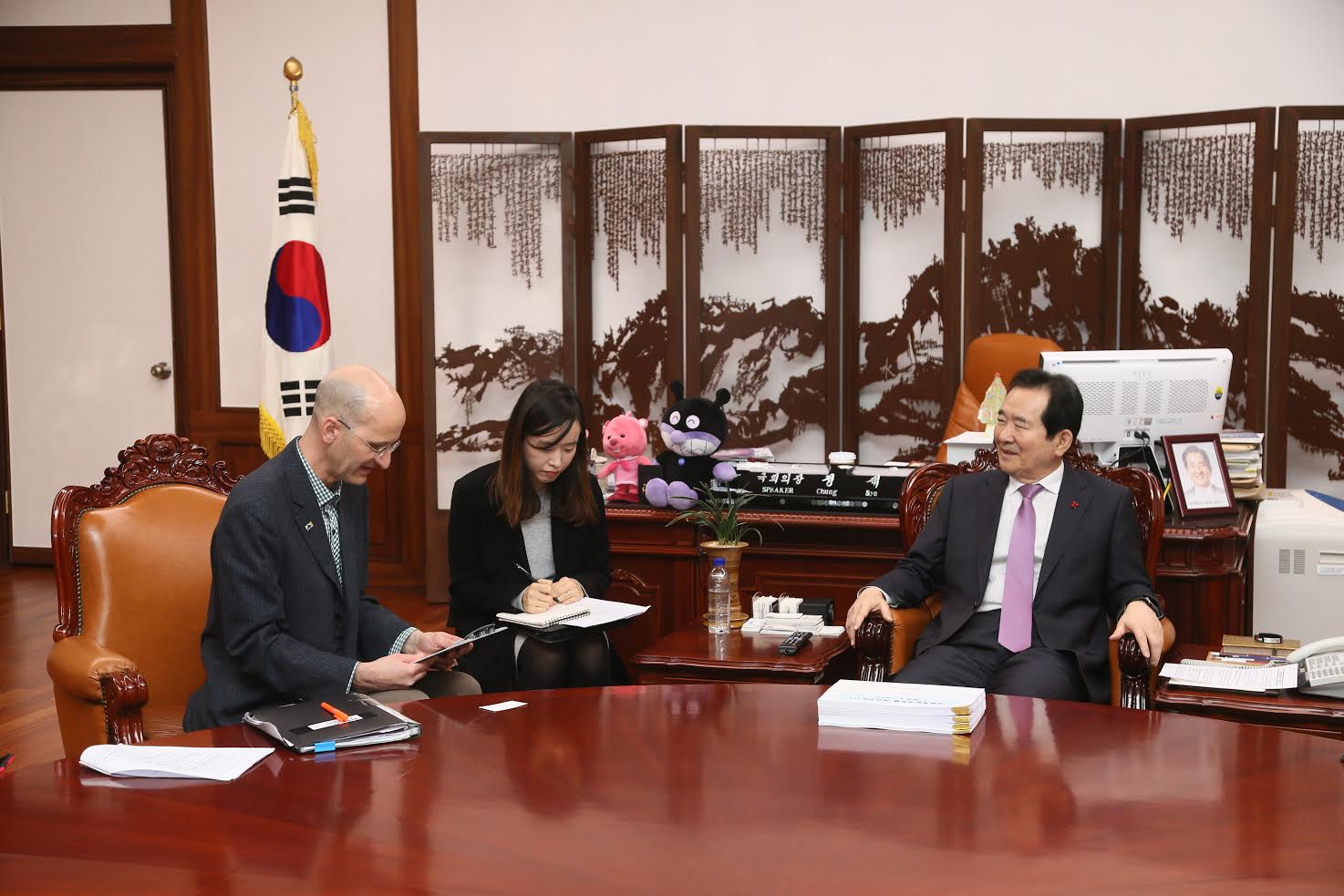
I had a chance to speak with Chung Sye-kyun, Speaker of the National Assembly, about his vision for Korean politics and his thoughts about what possible reforms may result from the current impeachment crisis. Speaker Chung spoke frankly about his hopes for meaningful and visionary constitutional reform and plans to address such knotty issues as the government-mandated history textbooks.


Emanuel Pastreich:

What exactly is this consultative body made up by the ruling and opposition parties for the period of the impeachment proceedings?

Chung Sye-kyun:

Under normal circumstances, the National Assembly would perform its role as legislative branch of government establishing laws. The central government, similarly, would play its administrative role. But we find ourselves in an emergency situation, one in which the president’s administrative authority is legally suspended and the prime minister has taken up temporary authority. But in the middle of all this we are facing a broad range of challenges both at home and abroad.

It is in that sense that the opposition party has called for a “consultative body for the ruling and opposition parties” or “consultative body for government administration.” Regardless of the name used, we need to consider the original function of the National Assembly: overseeing the actions of the executive branch and checking its actions. Simultaneously, the National Assembly also is charged with making legislation.

But this time we must increase the National Assembly’s role of oversight of, and checks on, the executive. As for the serious pending issues that we face, is it not the case that the National Assembly needs to address them? We have a critical contribution to make.

It was in the context of discussing this problem that suggestions for “political collaboration,” to use a popular term, came up. There are four (updated from three) negotiating parties in the National Assembly now involved in this political collaboration and we intend to cooperate with those in the legislative and executive branches. It is in that sense that that the ruling and opposition parties came up with this concept of a “consultative body for national affairs.” I think that such collaboration will allow us to move beyond the emergency situation of the present day and we want to make best use of the time we have. We need to work hard for such political collaboration so that the National Assembly, the entire government and the people of the Republic of Korea can respond to this emergency.


Emanuel Pastreich:

What are the priorities for this consultative body for national affairs, and what role do you expect to play?


Chung Sye-kyun:

There are many issues we must address and not so much time, but I think that the people’s livelihood and the economy are the primary issues for citizens. The new most important issue is the response to new developments in foreign affairs and security, especially those related to North Korea’s nuclear weapons program.

I hope that the members of the National Assembly, and all members of the political parties, will engage in a serious discussion about these two critical issues and that they will actively seek out ways to support the government so that reform and governance goes forward smoothly.


Emanuel Pastreich:

The possibility of constitutional reform has been brought up repeatedly before. There are those who see this crisis as the perfect opportunity to revise the constitution. And then there are some who hold that constitutional reform can be a means of sharing power with the so-called “third zone.”What are your thoughts on constitutional revision?

Chung Sye-kyun:

Constitutional revision must first and foremost take place in accord with the understanding of our citizens. And only on that foundation that can we proceed smoothly with constitutional revision. We will also need each political party of the National Assembly to reach an agreement on the process. As it seems pretty much certain that elections will be held early, following the impeachment, it will be rather difficult to carry out any sort of constitutional revision before the election. In any case, we are planning to set up a special committee on constitutional revision in the National Assembly next year.

For this reason, politics and the preparations for the upcoming elections should proceed along one track and the current judgment on the president of the Constitutional Court’s impeachment proceedings should proceed along its own track. Constitutional revision should be debated separately and treated separately.

The term “third zone” refers to the formation of another faction by those who have left the major parties. These politicians could pursue a different approach to policy, coalescing into a larger political force. It is possible that they might even try to field a candidate for president. It does not appear, however, that they have come together as a viable force in Korean politics. These politicians would have tried increase their influence if there had not been any impeachment proceedings. But now with the impeachment proceedings (and early elections) they will not have much leisure to prepare for an election and I think it will be rather difficult to field a candidate.

As I noted before, the ruling on impeachment of the Constitutional Court and the early presidential election are also quite distinct from constitutional revision. No one has any idea when such constitutional revision might take place. Nevertheless, although we do not know when the constitution might be revised, I would like to achieve this goal during my term of service.

The most important aspect of constitutional revision is the redistribution of power. The authority of the president should be reduced and transferred to the legislature, or to other government offices, so as to create a more horizontal distribution of power. In addition, there needs to be an allotment of administrative authority concentrated in the central government to move over to local government as well.

It is an issue of the fundamental rights of citizens. Whether we are talking about environmental issues or sustainable development, I think that a broad range of issues should be addressed in the process of constitutional revision. It is a question of the power structure. We need to do more than address institutional architecture. We must respond to the many changes and developments that have taken place in Korea over the last thirty years. Those developments should be reflected in the revision of the constitution.

Emanuel Pastreich:

How do you view the impeachment proceedings, especially as related to the impending early presidential election or the revision of the constitution?

Chung Sye-kyun:

The fact that 62 members of the ruling party voted for the impeachment in the National Assembly reflects the will of the people. Polls show that 78 percent of the nation supported the impeachment, which is about the same as the percent of the assemblymen who voted for impeachment in the National Assembly. From this fact, we can infer that public opinion has had impact on the decision of the National Assembly members.

Since the impeachment issue has already been passed on to the Constitutional Court, I anticipate that the Constitutional Court will make a prudent and wise decision. However, this is not to say that we know exactly how the Court will decide.

At present the members of the National Assembly need to systematically, in a transparent manner, discuss the basis for constitutional reform. It appears that many who participated in the demonstrations watching very closely how the impeachment hearings progress now that the case has moved to the Constitutional Court. They are ready, as committed citizens, to reconsider their positions on Korean politics in accordance with developments.

We must not lose sight, however, of the current issues critical to Korea. We must effectively resolve pressing issues such as the bird flu outbreak (AI), problems in the economy, and challenges for security and diplomacy. We can at the same time and proceed with the political process of resolving the crisis in a democratic, peaceful, reasonable and orderly way.

Emanuel Pastreich:

But there are some people who are worried that not everybody has the vision that you have, that there are politicians who are more concerned about the next election than any long-term reforms. So how would you make sure that we are focused on the big question of the Constitution and of the future of Korea, rather than short-term benefits?

Chung Sye-kyun:

It is quite natural for politicians to want to win elections and that is how things should be. We also need to confront current challenges and to think about the future of Korea. I must run for office and I must also fulfill my duties as the speaker of the National Assembly. The same goes for others.

Those who want to run in the presidential election must try hard to win the support of the people. But we have already seen the degree of commitment of our citizens to good government in the recent protests. They clearly feel a responsibility to carry out their role as citizens. It is for this reason that I am optimistic that no problems would arise.

Those who wish to be candidates for president ought to compete in a fair manner and thereby be scrutinized by the people. In this process, they should offer their visions and compete openly with each other to offer solutions. I hope that a good leader will be chosen in the end.

Additionally, I hope that presidential candidates will offer a concrete vision to the people, rather than employing a negative campaign. I understand that there is little time left in the process. Nevertheless, I hope that the candidates would make meaningful pledges for good government and will receive the support of citizens in return, thereby carrying out constructive campaigns.

Emanuel Pastreich:

A sample of the new government-mandated history textbook was released recently and set off protests calling for its recall. How should be address this problem, especially in light of the process by which this textbook was produced?

Chung Sye-kyun:

I have always strongly opposed the idea of government-mandated textbooks. This is not because of ideological or political bias, but rather because I feel we must employ a balanced and objective manner of considering history as we undertake the awesome task of educating of future generations. If we look at the issue in terms of our mission to the future, I believe, we must admit that Korea has developed sufficiently to no longer require government-mandated history textbooks.

I think the right approach is to have approved history textbooks, rather than government-mandated textbooks. The vast majority of Koreans oppose government-mandated textbooks, but they agree it is appropriate to have approved textbooks. I hope that the administration will quickly abandon this policy.


“The Greatest asset of Korea is our people” Speaker Chung Sye-kyun (January 3, 2017 Huffington Post)

Huffington Post

“ ‘The Greatest asset of Korea is our people’ Speaker Chung Sye-kyun on Impeachment and Korea’s future”

January 3, 2017

speaker-chung-sye-kyun

Emanuel Pastreich

Chung Sye-kyun became speaker of the National Assembly when his Democratic Party of Korea swept to victory in the June elections last year. The conservative Saenuri Party had taken a tremendous fall because of the fading appeal of its neo-liberal policies.

A senior figure in Korean politics with a balanced personality, Chung is not quick to make emotional judgments, but rather focused on creating harmonious relations within the political sphere. He has a passion for institution building. He has emerged as a central political figure in Korea during the impeachment proceedings of President Park Geun-hye.

I had a chance to talk to him briefly about Korea’s current political crisis and his perspective on the challenges, and possibilities, that lie ahead. As a man in the eye of the storm, he is perhaps best positioned to give an accurate assessment.

Read more