This article is an interview with Emanuel and Kim Taegyong (김태경 소장), Director of the Korea Institute of Patent Information (특허정보원 ), about education, technology and Korea’s future in the Monthly Journal, Patent Information Promotion Center Magazine (November, 2011).
Emanuel’s Talk at TED @ Hongreung about Korea and his Grandmother
Emanuel’s talk about a dream of his grandmother at TED X Hongreung
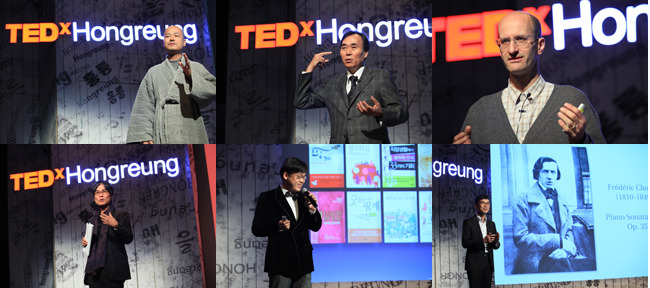
Emanuel gave a talk about a memory dream he had about his grandmother when first studying in Korea at the recent TED event. Hongreung is the name of an old neighborhood (named after a royal grave) in northern Seoul that has become the center of a research cluster defined by Korea University, KAIST, KDI, Kyung Hee University Hanguk Sook of Foreign Studies and KIST.
Link to the video:
“A Dream of My Grandmother on New Year’s Eve in Korea”
TED X Hongreung
October 29, 2011
“A Dream of My Grandmother on New Year’s Eve in Korea”
Talk for UST
November 15, 2011
Emanuel delivered a talk at KIST for students enrolled in UST (University of Science and Technology) an innovative technology program run jointly by a group of research institutes in Korea. The talk concerned the impact of technology on society and presented an assessment of the challenges faced currently by the young generation.
The students are from around Asia, but includes a large number from the Middle East. We entered into a very lively discussion about technology after the talk.
“The Observable Mundane” Recognized as outstanding study in comparative literature
November 15, 2011
Emanuel’s study of the reception of Chinese vernacular narrative in Korea recognized as outstanding study in comparative Asian literature.
The Senior Committee for the East Asian Literature Research Association (동방문학비교연구회) has selected “The Observable Mundane : Vernacular Chinese and the Emergence of a Literary Discourse on Popular Narrative in Edo Japan” (Seoul National University Press, 2011) for its annual award as outstanding research work on East Asian comparative literature.
Asia Institute Seminar (November 13, 2011)
The Asia Institute seminar brought together a broad range of experts and students, including students from Japan and even an individual originally from North Korea, to discuss what youth in Korea can do to prepare the way for the future reunification of the Korean Peninsula. The participants broke into two groups: one discussing in Korean and one in English. The results of the seminar will be forthcoming as a short paper.
Talk at POSTECH on the Future Challenges we face (November 11, 2011)
Emanuel delivered a talk in Korean at POSTECH on Friday, November 11 entitled “A Global Perspective on the Challenges of the Future.” The audience consisted of a group of POSTECH undergraduates with a deep concern about the future of education and their role in society..
Emanuel described the serious challenges posed by climate change, the superannuated society and rapid technological change. He stressed the need to focus education in science in technology on addressing these issues, rather than simple applications like displays and smart phones.
Review of Winslow Wheeler’s book on defense spending “The Wastrels of Defense” (article)
Here is Emanuel’s review of Winslow Wheeler’s book on defense spending “The Wastrels of Defense” as it appears on the site of the Center for Defense Information
“Rebels Within the U.S. Federal System ”
Emanuel Pastreich
January 10, 2006
Casually observing the mainstream media in
the United States gives one the impression that conservatives support the
administration of George W. Bush and the Republicans in Congress. Nothing could
be further from the truth. In fact, the most strident and damning attacks on
the “neo-conservatives” come not from “liberals,” but
rather from conservatives themselves. Moreover, although many Americans
foolishly buy into the argument that they should be afraid of “government,”
in reality, those in government have provided the strongest resistance to
corruption and corporate manipulation.
An excellent example of the rebellion
against the present rule of money and privilege in America is Winslow Wheeler.
Like the Democratic senator John Murtha, who recently called for U.S. troops to
be withdrawn from Iraq unconditionally, Wheeler is an insider with strong ties
to the military and the institutional culture that has dominated the U.S. for
the last 40 years who decided things have gone too far and has taken a stand.
He has written at length about the corruption in the military procurement
system, which is so deep that it poses a serious security threat.
“Korean Technology Beyond Motherboards and Displays” (article in Korea IT Times)
KOREA IT TIMES
Korean Technology Beyond Motherboards and Displays
Taekwando and Oriental Medicine at the Center of Korea’s Future
Thursday, November 10th, 2011
Emanuel Pastreich
http://www.koreaittimes.com/story/18156/korean-technology-beyond-motherboards-and-displays
The term “technology” demands our special attention because the challenges we face require us to move beyond the rather limited significance assigned to the word. “Technology” generally refers to applied techniques for design and the fabrication of parts for the electronics industry, and to a lesser degree to mechanical engineering, energy generation, and biotechnology. But rapid changes in society such as the environmental crisis and the aging population are putting great pressure on us to expand the definition of technology to allow for new and novel solutions. As Albert Einstein said, “We can’t solve problems by using the same kind of thinking we used when we created them.” Technology also must be taken up to another level.
The Environment Crisis: Don’t cut Defense Budgets!
It is one of the terrible ironies of this moment that at the same time that we are seeing reports that carbon dioxide emissions jumped 6% between 2009 and 2010 (with the United States and China leading the pack as linked economies), military budgets for traditional warfare are skyrocketing. People seemed to be still deluded into thinking we will fight the next war with missiles and aircraft. The climate war is here, but we are unprepared.
The solution is not to ask ministries of defense to cut their budgets and dedicate that money to planting trees. We all know that as good as the intention may be, such an approach will never work. The only solution is to redefine the concept of “security” and increase the amount of spending within defense ministries on environmental issues. Innovative countries like Korea are capable of making the transition. The only question is whether they can do it quickly enough.
Some individuals may disdain the idea of working closely with the military or “militarizing” the issue of the environment. I would argue that we really do not have any choice at this point.
STS Forum in Kyoto
Emanuel attended the STS Forum in Kyoto (October 2-4, 2011), meeting with individuals from industry, research and NGOs concerned with the impact of technology on society. There was a strong focus on the challenges of nuclear power in the conference and energy in general.