 Although there remains a strong sense of ethnic pride in Korea, you need only look at TV today to see an organized effort to introduce people from around the world in the most friendly and non-confrontational manner. It is clear that there is an imperative now to ride the wave of multiculturalism, creating a new Korea and avoiding the terrible fate of a super-annuated society.
Today in Korea
So Easy! On-line Law Suits
 You have to hand it to Koreans for their efforts at innovation. this advertisement states” So easy, it’s great! So convenient, it’s great!” The advertisement is for a new online system for filing law suits. What a concept: cyber litigation. I have not had a chance to look into the details about this Korean e-government innovation, but I must confess I am intrigued.
Trying to improve Seoul’s architecture: From Cookie Cutter to Avant Garde
Seoul is has not been known for its creative architecture. In terms of innovative design in architecture, Shanghai and Beijing have been ahead of Seoul in many respects. But we can see creeping up everywhere signs of a more innovative approach to architecture. In this case, we see a rather nondescript office building with the silhouettes of heads as a pattern on the first floor.

Today, May 21, 2011, Seoul had an enormous party to launch the floating islands in the Han River, a massive project to create a truly innovative space. The islands were officially opened last year.
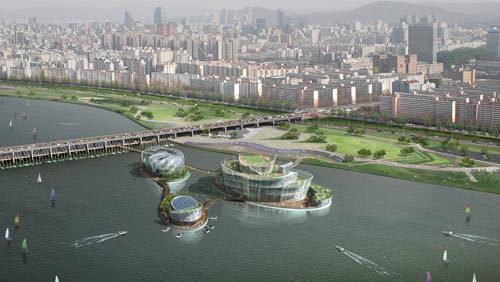
http://joongangdaily.joins.com/article/view.asp?aid=2916254
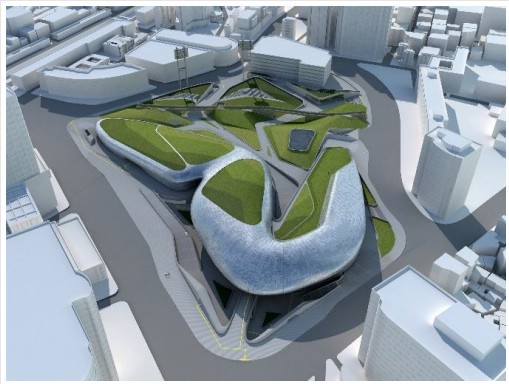
Opening soon is the Dongdaemun Design Park which will certainly be unlike anything seen in Korea before. We see everywhere signs that Seoul is making a serious bid to be a competitor with Singapore for the value-added culture and education center of Asia. Although English language is a challenge, we are guessing that people will start taking Seoul quite seriously in the near future.
Convergence and Art
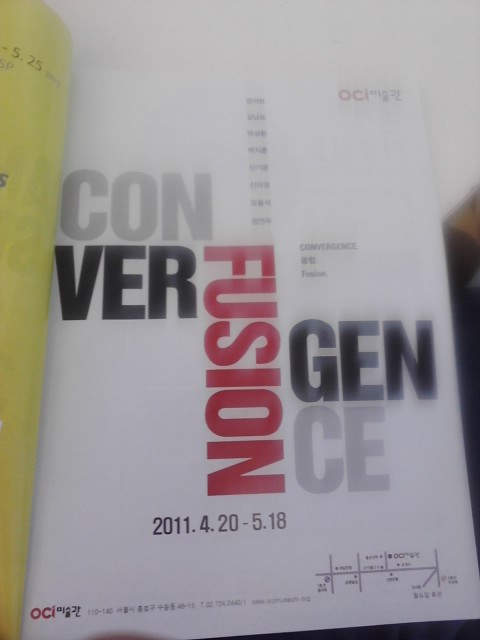
Convergence is not just about technology. It is an overarching term that increasingly concerns artistic expression. We see an increasing number of artists, museums and other institutions advocating a coming together of disciplines. Here a page of note from an art magazine.
Daum Interactive Map in Seoul Metro
 Daum, the online search engine that once was the dominant force fell behind Naver in recent years. But its new Daum Map offers quite detailed walk-through tours of much of Korea that are quite impressive. Now in subway stations we find these large interactive maps that allow passengers to scan the neighborhood around the station and pinpoint restaurants, hotels and other important facilities.
Unique Cultural Space in Itaewon
“Unique Cultural Space Thrives in Itaewon”
Interview with Director Paik Haeyoung of the Paik Haeyoung Gallery
KOREA BUSINESS CENTRAL
By Emanuel Pastreich
The hills above Itaewon are speckled with handsome homes—many of which are surrounded by high walls hiding elegant gardens. There is one home, however, that is always open to visitors, serving as an artistic commune, where the owner can be found sitting at the table in front discussing art, society and culture with whomever joins her. Her name is Paik Hae Young and her eponymous Paik Young Gallery is a unique experience, a breath of fresh air in an age of commercialism and consumption. Her house is a communal space for artists, those interested in art, children and a variety of like-minded souls.
The Paik Hae Young Gallery is dedicated to promoting Korean artists abroad and introducing international artists to Korea. The emerging artists and established artists who visit here bring with them a tremendous variety of skills. The gallery displays works of art, but also invites artists to stay in the delightfully airy guest rooms upstairs, creating art, talking about their art and interacting with artists and lovers of arts from all walks of like. We find critics, artists, journalist and professors drawn to this oasis in Seoul.
Opening in 1977, the Paik Hae Young Gallery is a major dealer that introduced important Korean artists to the world. It has since broadened its role from the dealership to agency for cultural affairs including art consulting for corporations, academy program for collectors and architectural consulting.
Remarks Director Paik, “I started as a pianist and was led to start collecting art when I was living in New York in the 1980s. I collected primarily American art and had close relations with, and collected the work of, Korean artists active in New York City. When I returned to Korea in 1988, I started the
[CONTINUED]
http://www.koreabusinesscentral.com/forum/topics/unique-cultural-space-thrives?xg_source=activity
“Walk on the Right!”
 A highly-organized campaign has been pursued in Korea for the last two years to encourage people to walk on the right on stairs and hallways. Somehow that act of properly walking up the stairs on the right hand side is perceived as the key to becoming a “developed” nation. The progress is considerable, but still not perfect. The decision to call for citizens to walk on the right strikes at the heart of the difference between Korea and Japan, or Germany: a certain free-for-all behavior in public spaces. We have been impressed, however, at how quickly Korea is catching up.
Call for designs for a new Seoul
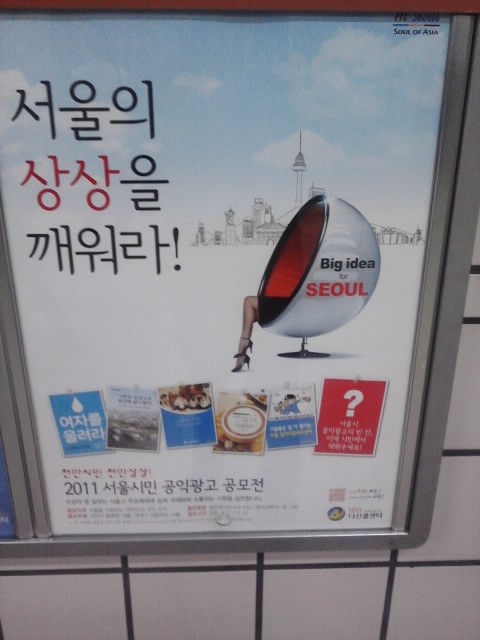
This sign in Seoul Metro calls for big ideas to transform the city. The participatory nature of the call is remarkable, and I have the impression that the proposals submitted by us foreigners and Koreans will be taken seriously. A remarkable moment.
Technology Transfer
One of the great myths of technology transfer is that it must be from developed nations to undeveloped nations. In the case of environmental conservation, one of the key issues is how to use fewer resources. For example, how do you wash all your dishes and take a bath with a liter of water in a relatively sanitary manner. This skill is completely lost on citizens from developed nations, but the technology remains with those from poor nations. We should make an active effort to import their technology to countries like Korea, the United States or Japan.
Kyung Hee University on Herbology and Pharmacology
Kyung Hee University is best known for its program in traditional Korean Medicine in Korea. Recently that program has become quite active.
Professor Kim Namil of Kyung Hee University oversaw the translation into English of “Donguibogam” (Principles and Practice of Eastern Medicine). This massive encyclopedia of traditional Korean medicine has previously been inaccessible to Western scholars. The translation was carried out with the support of UNESCO after UNESCO recognized Donguibogam as a “World Documentary Heritage” in 2009. This masterpiece of Heo Jun in 25 volumes is being translated piece by piece.
The work of Professor Ryu Jaehwan, also of Kyung Hee University, is quite significant in the same regard. He is currently conducting research on the supplementary use of traditional Korean medicine in the treatment of stroke victims. It appears that the benefits are striking, although many doctors have little interest.