The Problem of Introducing Korea Overseas (essay)

The Problem with how Korea is Perceived in the United States
Emanuel Pastreich
November 17, 2012

I worked at the Korean embassy in Washington D.C. for two years from 2005-2007. During that time I served as the editor-in-chief for the official magazine of the Ministry of Foreign Affairs online newspaper “Dynamic Korea” and also as the director of a think tank in the Korean Embassy, known as the “KORUS House,” that ran a very successful lecture series for diplomats, reporters, scholars and businessmen. The experience was tremendously exciting and I much enjoyed the time I spent in that wonderful little room on the fourth floor of the Culture center. There was a small window with a delightful view out over Rock Creek. It was my first time working with Koreans in a serious manner. At the time I was determined to help in the effort to make Korea better understood among policy makers in Washington D.C.

Read more

Emanuel’s talk on the problem with islands: Solutions for the Senkaku-Diaoyu Conflict

“The Problem with Islands:

Long term solutions for the Sengaku-Diaoyu conflict”


Emanuel Pastreich

Director

The Asia Institute

November 2, 2012


The Senkaku Islands (Diaoyu Islands in Chinese) are a set of uninhabited islands not far from Taiwan, the coast of Fujian, People’s Republic of China, and the Japanese island of Yonaguni in Okinawa that have become the site for remarkable dispute between China, Taiwan and Japan. The collision between the Chinese fishing trawler Minjinyu and a Japanese coast guard vessel on the morning of September 7, 2010 (and the subsequent detention and release of the captain of Minjinyu) made a long-brewing dispute over territory into a cause célèbre in China that has taken the form of a series of protests in both China and Japan of a severity not seen in since the Cultural Revolution.

The announcement by the City of Tokyo that it would buy the Senkaku Islands from its private owners, thus conflating private real estate with national territoriality, set off an even more virulent set of protests in China in 2012 that have created a sense of distrust and foreboding in Asia at a time when many looked forward to an age of increasing economic and cultural exchange. 2012 was slated for a series of celebrations to commemorate the fortieth anniversary of the normalization of relations between Japan and the People’s Public of China. All of those events have been cancelled or postponed. In fact, even an innocent conference of comparative literature to which I had been invited was abruptly cancelled. On the Japanese side as well, protests are planned and emotions have run high—a marked contrast to previous demonstrations that were widely ignored in Japan.

[more]

Link to original paper

“The Moral Equivalent of War: Joining with our Chinese Neighbors to Stop the Spread of Deserts in Northeast Asia” by Ambassador Kwon Byung Hyun

This article by Ambassador Kown Byung Hyun, the founder of Future Forests, explains vividly the effort to get youth in both Korea and China involved in the enormous project of confronting the threat of desertification. Future Forests is a close partner of Asia Institute and this article presents quite well the important work that Ambassador Kwon has undertaken.


Ecocity Media

November 2, 2012

link to original article


The Moral Equivalent of War: Joining with our Chinese Neighbors to Stop the Spread of Deserts in Northeast Asia

By Ambassador Kwon Byung Hyun
Former South Korean ambassador to China
Founder & President Future Forest


It seems as if we are constantly preparing to fight the last war and completely unprepared for new challenges. But one needs only travel to the edge of the Kubuchi Desert in Inner Mongolia to see that mankind faces threats on an unprecedented scale that call our for our united action. We must use the full extent of our imagination to come up with solutions to this crisis through new global alliances that require us to completely rethink terms like “security” as we create a new civilization that can lead humans from the dark night of endless consumption to a hopeful future.

My engagement in the long-term effort to stop the spread of deserts in China started from a very distinct personal experience. When I arrived in Beijing in 1998 to serve as ambassador to China, I was greeted by the yellow dust storms. The gales that brought in the sand and dust were very powerful and it was no small shock to see Beijing’s skies preternaturally darkened. I received a phone call from my daughter the next day and she told that the Seoul sky had been covered by the same sandstorm that had blown over from China. I realized that she was talking about same storm I had just witnessed. That phone call awakened me to the crisis. I saw for the first time that we all confronted a common problem that transcends national boundaries. I saw clearly that the problem of the yellow dust I saw in Beijing was my problem, and my family’s problem. It was not just a problem for the Chinese to solve.

Read more

Upcoming Asia Institute Seminar: “Approaches to the Resolution of Conflict The Role of the Global Civil Society in Constructing a Peaceful Community” November 2, 2012


GCS and Asia Institute

International Peace Seminar to Commemorate

The 31st Anniversary of the UN International Day of Peace


Friday, November 2

10 AM – 12 PM


Topic:

“Approaches to the Resolution of Conflict

The Role of the Global Civil Society in Constructing a Peaceful Community”


The world faces a remarkable number of conflicts today that call for a global effort to bring about long-term resolution.  GCS (Global Common Society) and the Asia Institute have undertaken a concerted effort to identify effective strategies for engaging a variety of stakeholders through work with NGOs and educational institutions to lay the foundations for long-term engagement.  In commemoration of the 31st Anniversary of the UN International Day of Peace, GCS and the Asia Institute will hold a seminar to discuss how the global civil society create the precedents for a global culture that promotes peace.

Introductory remarks: Mr. Charles Cho, Executive Director of GCS

Moderator: Mr. Charles Cho, Executive Director of GCS

Speaker:

Emanuel Pastreich

Director of the Asia Institute

“The Problem with Islands: Strategies for addressing the Sengak-Diaoyu Islands Issue through Education and NGO cooperation”

Speaker:

Baeksoon Lee

Director-General

Ministry of Foreign Affairs and Trade

“Korea’s role in promoting peace”

Speaker:

Lakhvinder Singh, Ph.D.

President of the Indo-Korea Policy Forum

“India’s innovations in encouraging peace and conflict resolution”

Date: Friday, November 2


Time: 10 AM – 12 PM


Location:


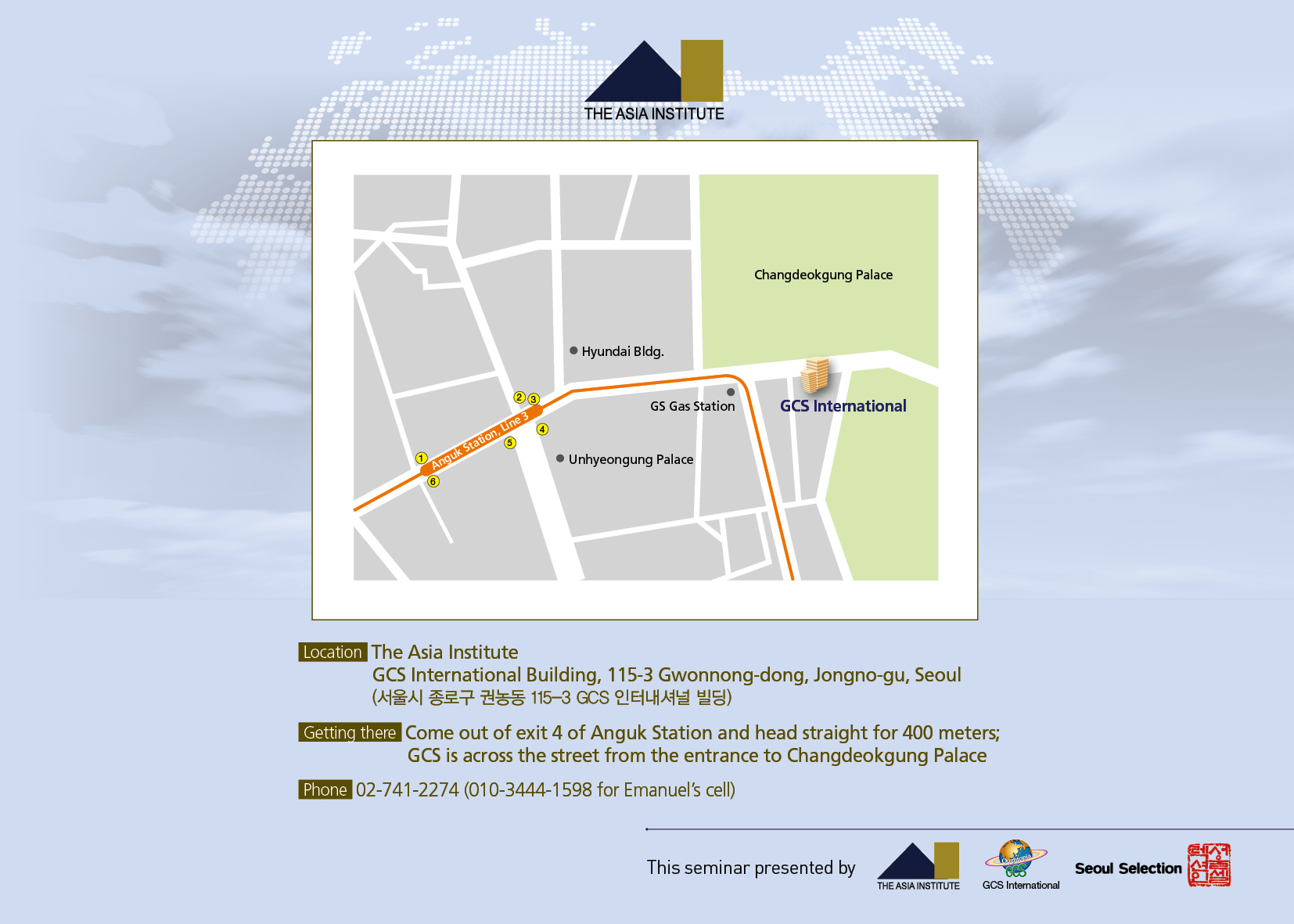
The Asia Institute and GCS International Headquarters

GCS International Building

115-3 Gwonnong-dong, Jongno-gu, Seoul

02 741 2274

Emanuel’s thoughts on the Korea China University Student Forum and the Environment

As part of my ongoing work as adviser for Future Forests, the NGO dedicated to combating the spread of deserts in China, and throughout the world, I was invited to serve as the judge for a series of talks by Chinese and Korean students about how we can come together to fight the environmental crisis—most specifically desertification in Northern China. The series of talks were held at Sungkyunkwan University on October 24, 2012 and featured five teams making PowerPoint presentations about

Korea China University Student Forum, October 24, 2012


“Wise Words of Confucius on Shifts in Institutions” from Asia Institute

Asia Institute Essay:

“Wise Words of Confucius on Shifts in Institutions”

Emanuel Pastreich

October 22, 2012

Confucius argued that the most critical issue for a healthy society is the relationship of the terms we employ to the institutions and objects that they describe. Now, in an age of increasing incoherence and confusion about the most basic terms used to describe our society and economy, Confucius’s insight offer us an invaluable perspective. His suggestion that it is the discontinuity between terms we use and the practice they describe, rather than simple unethical behavior and greed, that produces these contradictions presents us with a means of going beyond the unproductive argument all problems stem from the fact that a small group of the powerful are too greedy. Knowing that a small group of powerful people has immense control does not does not help us understand how we got in this situation, or how we can get beyond it.

Read more

Asia Institute Seminar with Robert McChesney “Korean Media in Comparative Perspective”

Asia Institute Seminar


May 9, 2012


“Korean Media in Comparative Perspective”


Robert W McChesney

Gutgsell Endowed Professor in the Department of Communication

University of Illinois


Emanuel Pastreich:

The reliability of the mainstream media has become an enormous issue in Korea today as many feel that the newspapers and television broadcasts no longer serve a role of keeping citizens informed. Recently the TV comedy show “I am a Selfish Prick” (“Nanun Ggomsu da”)  was rated as more accurate than the mainstream media—even though most of its content is tongue in cheek. What exactly is the problem with media and how can we approach it?

Robert McChesney:

Firstly, one must begin understanding that the media is a problem for Korean society. By “problem” I do not mean that the media is poor quality or produces dubious content that has negative effects upon our culture, politics, and society. By this framing, if the media were doing a commendable job, there would be no problem. Whether their content is good, bad or a combination, the media is a problem for any society, and an unavoidable one at that.  The problem of the media exists in all societies, regardless of their structure.

Emanuel Pastreich:

So the very existence of media in any country, not just Korea, will bring forth issues that are problematic. Is that is to say there is not a pure state of an objective media that we could reach if we just follow a certain set of policies? To become a democratic society does not make one immune from such problems?

Robert McChesney:

Media are at the center of struggles for power and control in any society, and this is arguably even more the case in democratic nations, where the issue is more up for grabs.

The political nature of the problem of the media in democratic societies is well-known, virtually all theories of self-government are premised on having an informed citizenry, and the creation of such an informed citizenry is the province of the media.  The measure of a media system in political terms is not whether it creates a viable democratic society, but whether the media system, on balance, in the context of the broader social and economic situation, challenges and undermines anti-democratic pressures and tendencies, or whether it reinforces them.  

Read more
Asia Institute Seminar with Larry Wilkerson “The Real Issues on the Korean Peninsula”

Asia Institute Seminar


“The Real Issues on the Korean Peninsula”


August 28, 2012


Asia Institute Seminar


“The Real Issues on the Korean Peninsula”


August 28, 2012


Larry Wilkerson

Pamela C. Harriman Professor of Government and Public Policy

College of William & Mary

(former Chief of Staff, Department of State) 


Emanuel Pastreich:

So the conflict between North Korea and South Korea just goes on and on. We can blame this state on this president or that administration on the Northern side, or the Southern side but clearly the problem goes beyond the capacity of one individual, or even a group, to change. What might be a new way of tackling this problem?

Larry Wilkerson:

I have a solution. I am not sure that it is a politically acceptable solution. Certainly it would not be acceptable to any United States administration we are likely to encounter soon. But this solution deserves to be discussed. I can sum it up succinctly: get the United States out of the process. When I say “get the United States out”I don’t necessarily mean, although it may be possible in the future, the removal of United States forces from South Korea. That is a step that would come later.

The first step is to get the focus away from nuclear weapons and nuclear power in all interactions with North Korea, and also to take the focus off of the United States and its concerns. The United States has developed a lumbering bureaucracy related to East Asia with its own complex security concerns in Northeast Asia that cannot represent the interests of the Korean Peninsula. Let us put the focus back on the Korean people themselves in both North Korea and South Korea.

I am convinced that if we let South Korea and North Korea go forward in their discussions without the constant interference of the United States, they will find a route to accommodation or reunification, whether through a “sunshine policy” or some very different route. Let them deal with the problem themselves. Although the man in the street is not aware of it, the United States is constantly interfering with the attempts of the Koreans to determine their own future.

The United States can offer its support to Korea, but not in the sort of obstruction and interference we have seen so far. When and if necessary, Korea can invite China, Russia and Japan to enter into the effort. That is the only real way to move towards reunification. Consistently the United States has gummed up the works. Requiring all these countries to be part of the process through the Six Party Talks is a perfect example.  

Read more