Emanuel attended the STS Forum in Kyoto (October 2-4, 2011), meeting with individuals from industry, research and NGOs concerned with the impact of technology on society. There was a strong focus on the challenges of nuclear power in the conference and energy in general.
International Relations
Professor Jung Min’s Study of the awareness of a “common realm” in pre-modern East Asia
I had the opportunity to meet with Professor Jung Min (정민 교수) of Hanyang University on September 28, 2011. I have the ultimate respect for Professor Jung, one of the most careful and insightful scholars of the classical Chinese tradition in Korea. He has also worked on Park Jiwon’s writings at length and we have shared notes before. He gave me a pile of intriguing articles and books, but one article in particular seized my attention. The title is
“Awareness of a “Common Realm” among 18th and 19th Century Korean Intellectuals”
Research Association for a Northeast Asian Community
Dr. Seungryu Lee serves as chairman of the Research Association for a Northeast Asian Community. This group meets frequently to discuss how economic, cultural and political integration between China, Japan and Korea can be achieved. The Research Association for a Northeast Asian Community met today (September 22, 2011) for a conference entitled “Constructing a Common Economic Community for the Korean Peninsula and the Search for a Path to Reunification.”
United Nations Academic Impact Seminar at Kyung Hee University
September 15, 2011
Kyung Hee University and the United Nations hosted a remarkable event entitled “Give Peace Another Chance” to commemorate the 30th anniversary of the establishment of the United Nations “Day of Peace.” The “Day of Peace” was originally proposed by the founder of Kyung Hee University and it was most appropriate that the United Nations chose Kyung Hee University for this event.
The event, which included speeches, statements by students, an address by Secretary General Ban Ki Moon and music performances, was split between United Nations Headquarters in New York City and Kyung Hee Campus in Seoul. Both groups were linked up via the internet.
More than 3000 students from ten universities were involved. The event was focused on United Nations Academic Impact (UNAI) an innovative program to increase the global role of universities and the commitment of students to proactive participation in local and global affairs.
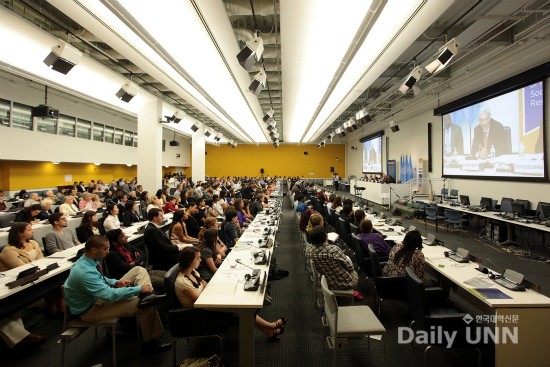
Academic Impact aligns institutions of higher education with the United Nations in actively supporting the then principles of the UN in the areas of human rights, literacy, sustainability and conflict resolution. The Academic Impact also asks each participating college or university to actively demonstrate support of at least one of those principles each year.
Secretary General Ban Ki-Moon’s address to “Give Peace Another Chance” is available here.
The significance of Peace Studies in 2011
My increased collaboration with the Graduate Institute for Peace Studies at Kyung Hee University, and my work with the Global Peace Festival Foundation in planning the November Global Peace Convention in Seoul has led me to think more deeply about the term “peace” and its significance in our age.
Two things are clear:
First, “peace” is growing in influence as a critical concept for responding to the challenges of our age and an idea with immense intellectual and emotional appeal.
Second, the concept of “peace” will require a thorough redefinition in light of significant changes in human society that have taken place and the new challenges that we face. We need to build a discourse on peace that is at least as nuanced and authoritative as that used for “security,” or for that matter that used for “economics.”
Panel on Transportation and Resources in Mongolia at “Mongolia and Northeast Asia Peace” Conference in Ulaanbaatar
Panel on Transportation and Resources in Mongolia at “Mongolia and Northeast Asia Peace” Conference in Ulaanbaatar
Emanuel Pastreich had the opportunity to head a panel of experts for a discussion of opportunities and challenges in the energy, transportation and natural resources sectors held at the Global Peace and Leadership Conference “Mongolia and Northeast Asia Peace.”
The Global Peace and Leadership Conference “Mongolia and Northeast Asia Peace” (August 25-27, 2011) was a remarkable event bringing together wide range of individuals and groups committed to a peaceful and fair approach to social, cultural, economic and institutional integration in Northeast Asia. The choice of Ulaanbaatar, Mongolia as the site has particular significance as Mongolia is a new power in the debate on Northeast Asian integration. As an emerging economic center, with vast mineral resources and a tradition of leadership in both Central Asia and Northeast Asia, Mongolia has been visited recently by Korean President Lee Myung Bak and United States President Joseph Biden (Vice President Biden was still in town when our conference began on August 25).
Is the United States a threat even if it is just minding its own business?
Most of us are still a bit vague about where all that money is going to be cut from the federal and state governments of the United States. Perhaps some of the cuts will come out of the bloated military budget, thereby reducing the threats that our troops around the world are subject to, and at the same time also generate. Certainly many who actually serve in the military would welcome such a reduction in spending.
But we need to start thinking about a new and unprecedented security threat on a global massive scale: the United States without safety protocols and effective inspection regimes for the vast range of dangerous materials collected over the last sixty years.
The United States is a pile of chemical waste dumps, aging nuclear power plants, nuclear materials—and weapons—storage facilities, oil rigs, oil pipelines, mines (active and abandoned), armories and any number of railroads and highways that require an enormous investment to maintain safely.
Response to “Is China the Nemesis in a New Cold War?”
This discussion concerns my article “Is China the Nemesis in a New Cold War?” Published five years ago, I think the points about the future of US-China relations remain relevant today. It was originally published in the Nautilus Institute. I had input from Charles G. Coutinho, Ph.D. for the original article.
The Nautilus Institute
June 23rd, 2006
Response to “Is China the Nemesis in a New Cold War?”
by Emanuel Yi Pastreich and Charles G. Coutinho, Ph. D.
Response by Emanuel Yi PastreichI. Introduction
The following are comments on the essay “Is China the Nemesis in a New Cold War?” by Emanuel Pastreich, visiting scholar at the Center for East Asian Studies, University of Pennsylvania and a Japan Focus associate, which appeared as Policy Forum Online 06-18A: March 6th, 2006.
This report includes comments by Charles G. Coutinho, Ph. D. an independent scholar, having with a doctorate in the department of History at New York University in 1997. specializing in Anglo-American relations during the early Cold War.
The Economy of Information
I wrote this thought piece in April of 2000 at the very beginning of my consideration of the implications of technology for society and globalization. At the time, I was focused primarily on classical literature, but had been exposed to some discussions about technology at University of Illinois. The essay is erroneously titled “The Economy of Information.” It would be tempting to find a new title, but that act would create a historical inaccuracy. This essay is what led to much of my writings about the internet.
Computer Networks Recapitulate the Human Mind that Gave them Birth
The most interesting, and most powerful confluence in technology is the parallel process of genetic research and computer chip design. Perhaps the more appropriate terms are silicon & carbon engineering. At the very same time that the human genome is being mapped out and a one-to-one correspondence between the specific gene and the trait is imagined, increasingly minute wafer fabrication at a microscopic level is conducted at the same scale as the process of DNA replication. Both carbon and silicon engineering at the microscopic level are developing in parallel. Oddly, silicon engineering seems more and more like carbon engineering (DNA) because unlike previous technologies, like the sewing machine, or the automobile, today’s chip could not be readily replaced if the supporting technology for production disappeared. That is to say, if you destroyed all parts factories and research laboratories in the automobile industry, you could still produce a vehicle rapidly if you knew the principles of manufacturing. If we lost the factories and data behind a modern silicon wafer, however, we could not reduplicate because the previous generation of computer needed to design it, as the generation before that one was employed before it.
“DMZs Seen and Unseen” (Talk)
Emanuel Pastreich
April, 2003
Program in Arms Control, Disarmament and International Security
University of Illinois, Urbana-Champaign
DMZs Seen and Unseen;
The Real Challenges of Security and Culture in the 21st Century
We often think of North Korea, or Taiwan, as the last remaining traces of a cold war order that stand on the edge of collapse. We imagine that both problems may be resolved in the next decade, or perhaps even sooner, as economic forces overwhelm military and ideological conventions. Yet I would posit that we are perhaps being misled by our own preconceptions. How can it be that as tensions increase in the United States media and more spending for the military is approved in the Blue House that those on the street in Seoul seem to feel quite at ease with the current process of economic integration between North and South Korea, and an unprecedented group of South Koreans civilians have taken off for a ceremony in Pyongyang? How do we reconcile these divergent events? How can tensions mount between Japanand North Korea(or even South Koreaand Japan) at the same time that economic integration between North Koreaand China, Japanand South Koreacontinues unabated? Part of the situation derives from misunderstandings. Part of the situation derives from the unique challenge of a cultural and technological nature posed by the 21st century.