Emanuel on the North Korean Problem


The 5th International NGO Conference on History and Peace


Workshop on Universal Norms


(July 24, 2013)

Kyung Hee University

The North Korea Problem

The intractable problem of North Korea remains the greatest obstacle to integration in Northeast Asia, one that has consistently defied efforts at diplomatic resolution. Without any doubt, serious engagement on the North Korean crisis is the fastest road to meaningful and sustainable integration (to be distinguished from economic interpenetration that can evaporate, or even inspire a xenophobic backlash).

But most discussion about North Korea is simply not that serious. Granted there are great dinners offered at the Six Party Talks, but the content of those discussion is so limited (whether North Korea will stop its nuclear power program) and most of the problems, from trade and integration to climate change and the role of the nation state in a rapidly changing era—not to mention the failure of the United States to comply with its obligations under the Non Proliferation Treaty—are simply off the table.

James Baldwin made a statement that summarizes the essential issue for diplomacy in East Asia:

“Not everything that is faced can be changed but nothing can be changed until it is faced.”

It is critical for us to face the reality of the North Korean tragedy, and the manner in which that problem has evolved; then, on the basis of an entirely new conception of the issues, we can take meaningful steps to address it.
Read more

Pursuing opportunities with North Korea

I worry about North Korea and its future. But I also have high hopes for North Korea and its potential.

It is common sense that the way to solve the North Korean crisis is for North Korea to accept the norms of the international community and become a stakeholder.

But I would like to suggest that maybe the solution to the North Korean problem could also be the opposite approach. That maybe if we change our basic assumptions about international relations and security and how we address difficulties and disagreements, a solution can be found somewhere quite unexpected.

Perhaps the solution is for us to rethink the nation state as the basic unit of international relations, or to consider the environment, and other serious non-traditional threats, as the primary security issues for our future, and to redefine the role of finance, trade, technology and consumption in our society. Maybe the solution to the North Korean problem can be found in Peter Drucker’s famous adage, “Don’t solve problemsPursue opportunities.”

We should not be obsessing about how to solve North Korea’s intractable problems. Rather we should put forth a bold and inspiring vision for what possibilities are out there in Northeast Asia and encourage everyone to reach our for something beyond him or herself. When that happens, when a new hope takes root, the walls of separation will fall down, not because we tear them down, but because they no longer serve any purpose.

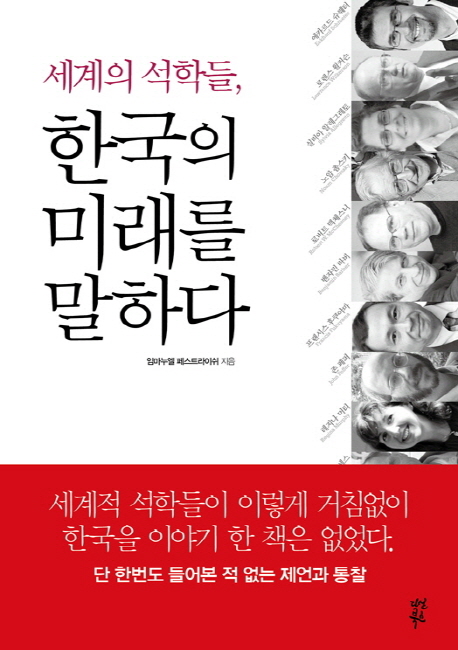
Scholars of the World Speak out about Korea’s Future from Dasan Books

Scholars of the World Speak out about Korea’s Future
Dasan Books
October, 2012
Edited by Emanuel Pastreich

Scholars of the World Speak out about Korea’s Future is a book in Korean language that presents the insights of distinguished scholars from around the world concerning contemporary issues in Korean politics, society and the economy. Released six weeks before the Korean national election, it treats issues such as education, social welfare, populism and North Korea that have been raised in the course of the campaign.
For the first time, a group of international experts present their views about the specifics of Korean society and the relationship of Korean domestic issues to larger global trends. Emanuel Pastreich, associate professor at Kyung Hee University and director of the Asia Institute, interviewed Benjamin Barber, Noam Chomsky, Francis Fukuyama, Lawrence Wilkerson and other important figures in an effort to give Korean readers an insights into how the problems they are faced are linked to larger global trends.

Read more

Asia Institute Seminar with Larry Wilkerson “The Real Issues on the Korean Peninsula”

Asia Institute Seminar


“The Real Issues on the Korean Peninsula”


August 28, 2012


Asia Institute Seminar


“The Real Issues on the Korean Peninsula”


August 28, 2012


Larry Wilkerson

Pamela C. Harriman Professor of Government and Public Policy

College of William & Mary

(former Chief of Staff, Department of State) 


Emanuel Pastreich:

So the conflict between North Korea and South Korea just goes on and on. We can blame this state on this president or that administration on the Northern side, or the Southern side but clearly the problem goes beyond the capacity of one individual, or even a group, to change. What might be a new way of tackling this problem?

Larry Wilkerson:

I have a solution. I am not sure that it is a politically acceptable solution. Certainly it would not be acceptable to any United States administration we are likely to encounter soon. But this solution deserves to be discussed. I can sum it up succinctly: get the United States out of the process. When I say “get the United States out”I don’t necessarily mean, although it may be possible in the future, the removal of United States forces from South Korea. That is a step that would come later.

The first step is to get the focus away from nuclear weapons and nuclear power in all interactions with North Korea, and also to take the focus off of the United States and its concerns. The United States has developed a lumbering bureaucracy related to East Asia with its own complex security concerns in Northeast Asia that cannot represent the interests of the Korean Peninsula. Let us put the focus back on the Korean people themselves in both North Korea and South Korea.

I am convinced that if we let South Korea and North Korea go forward in their discussions without the constant interference of the United States, they will find a route to accommodation or reunification, whether through a “sunshine policy” or some very different route. Let them deal with the problem themselves. Although the man in the street is not aware of it, the United States is constantly interfering with the attempts of the Koreans to determine their own future.

The United States can offer its support to Korea, but not in the sort of obstruction and interference we have seen so far. When and if necessary, Korea can invite China, Russia and Japan to enter into the effort. That is the only real way to move towards reunification. Consistently the United States has gummed up the works. Requiring all these countries to be part of the process through the Six Party Talks is a perfect example.  

Read more

“The Conditions for Engaging North Korea” Asia Institute Seminar with Jon Huntsman

“The Conditions for Engaging North Korea”

Asia Institute Seminar with Jon Huntsman

Former Governor of Utah & Republican candidate for President

9th April 2012


Jon Huntsman

American politician, businessman, and diplomat

Former United States Ambassador to the People’s Republic of China

Former Governor of Utah

Former Republican candidate for the 2012 Republican Presidential Primary


Emanuel Pastreich

Director

The Asia Institute

(Associate Professor, Kyung Hee University)

Emanuel Pastreich:

I wanted to ask you about the prospects for engagement with North Korea from your perspective as someone who has been intimately involved in the diplomatic debate concerning the future of North Korea. The question is not so much about the latest misdeed of North Korea, but rather about what the long-term prospects are. After all, if we want to solve the problem, we must move beyond the latest news cycle.

Many Koreans are confused because, on one hand there has been times of great efforts to engage with North Korea and these have been generally frustrated, and on the other hand there have been efforts to take a harder line towards North Korea at other times, and these efforts also, although they have been successful in some respects, haven’t resolved the problem either.  The question of what to do about North Korea has become a major issue in Korea today.  What do you think is the long term solution to this problem?

Jon Huntsman:

I am not sure we can find an easy answer when we are working with regime that is willing to put everything on the line in maintaining the status quo, in repressing its people with unprecedented cruelty and in saber rattling that sends tremors through the whole region.  I am one person who feels that nothing is going to happen in the short term with North Korea because we find ourselves in the middle of a transition right now and such political transitions always bring out unpredictable behavior from those in power.

Read more

Asia Institute Seminar with Dr. Vyjayanti Raghavan: “An Indian Perspective on the Korean Peninsula”

Asia Institute Seminar

June 2, 2012

“An Indian Perspective on the Korean Peninsula”

Dr. Vyjayanti  Raghavan

Associate Professor

Centre for Japanese, Korean and Northeast Asian Studies

Jawaharlal Nehru University


Emanuel Pastreich

How does the recent tension on the Korean Peninsula look from an Indian Perspective? India has obviously a profoundly different cultural tradition and historical experience. And yet we are quite aware of the fact that India has had any number of conflicts and disagreements over the last sixty years. After all, Pakistan and India were separated in 1947, the exact moment that the divisions between North and South Korea were forming.

Read more

Peace on the Peninsula through Art: Park Sidong’s Seokjangni Art Museum on the DMZ

Peace on the Peninsula through Art

Park Sidong’s Seokjangni Art Museum on the DMZ 

I first visited Park Sidong’s remarkable   Seokjangni Art Museum on the DMZ in March, 2012 after attending a seminar held at a military outpost overlooking North Korea. I was on a panel with artists and scholars discussing how an innovative residency for artists held right on the DMZ could serve as the first step towards bringing peace to the peninsula. The idea struck a chord with me. Could it be that rather than holding yet another seminar or writing yet another op-ed, just having artists practicing art could help facilitate the cultural and ideological shifts required to move beyond the current stalemate? I think there is that  chance.


The sculpture greeting the visitor


Read more